Loading enrollment options…
If sections and pricing don’t appear, email support@scholeacademy.com and we’ll help you enroll.
We float through space on terrestrial driftwood. Our Sun is but one star out of hundreds of millions in our galaxy alone, caught up in a river of star swirling about a galactic core nearly 25,000 light years away. We seem to be lost in the vastness, and yet we are not! We are loved, loved to the point of being able to be here, pondering in awe and wonder, as well a deepening understanding of the majestic patterns of the night sky and the laws that govern their mechanics.
Astronomy blends the best of classroom instruction with real-world observation. We have two classrooms, one on Zoom and one outdoors. We will learn about the patterns of our solar system, the constellations of the seasonal sky, and the phases of our moon, first through direct instruction, and then through direct observation. We will learn about the physics behind what we observe, but also about the mysteries left before us as we realize that we can only perceive so much, so far, and that there great questions remaining about even the most fundamental models we have about the cosmos. The course will culminate with a key observation project and a Simulated Space Mission, in which each student enters the role of NASA engineer, conceiving, designing, budgeting for, ‘building’, and role playing a launch-through-landing mission.
No special observing tools will be required for this course other than the basic course materials. If you have binoculars or a telescope, we will learn to use those more effectively in class, but the course is geared for the naked eye observer. In this way, every student can simply walk outside, let the eyes adjust, and have the cosmos unfurl before them.
This same course is available in the fall or spring. See the spring section here.
Required Materials: Books and supplies are not included in the purchase of the course. These resources are listed to help inform your decision-making as you make course selections and build your course schedule. Please reach out to the instructor if you have any questions about materials.
chris@alwayslearningeducation.net
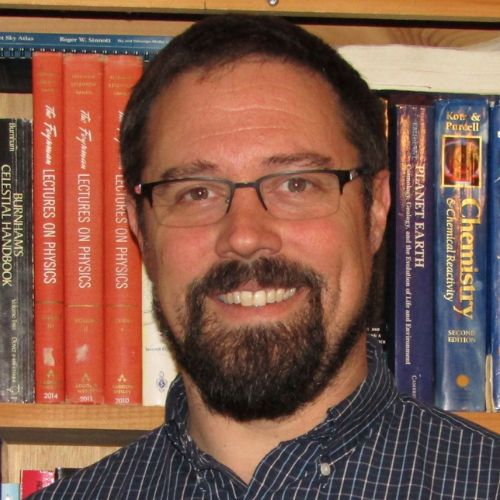
Chris Hall has a BA in Philosophy from Gettysburg College and an MAT in Elementary Education from Towson University. He has been a classroom educator and administrator for 30 years, having served in public, independent, and classical schools. He is a lifelong practitioner of several common arts, a musician, an amateur radio operator (WR5WD), and the Founder of Always Learning Education, an organization dedicated to teaching, learning, and propagating the common arts.
Chris lives on a small, homesteaded farm in central Virginia with his wife and three homeschooled sons.
1. Introduction to Astronomy- Cosmological Address, Scale, Measurement in Light Units 2. Introduction to Celestial Observation, Celestial Navigation 3. Fall Constellations and Asterisms 4. Celestial Mechanics and Mapping 5. The Life Cycle of Stars 6. The Solar System 7. Meteors and Meteorites 8. History of Space Exploration- Manned and Unmanned Missions
1. Simulated Space Mission 2. Winter Constellations and Asterisms 3. Messier and Other Deep Sky Objects 4. Artificial Satellites 5. Future Technologies: Propulsion Systems, Space Elevator, Asteroid Mining, Space Telescopes
First, read the available course descriptions, noting prerequisites, target grades, and course objectives. If you think your student is prepared for the course, go ahead and register. After registration, a placement assessment may be provided to students, depending on the course and the student’s previous enrollment with Scholé Academy. Registration is finalized when the student’s placement assessment has been returned by the course instructor with placement confirmation.
Make sure they don’t conflict with other activities in your schedule or other courses you are purchasing. Our system will not catch double-bookings!
Our Assistant to the Principal will be in touch with you after your enrollment to help you with next steps, including any placement evaluations that may be required for your course selections.
This registration will be finalized when the student’s placement assessment has been returned by the course instructor with placement confirmation.
This introductory course is designed for high school students who love science, are strong in math, and aspire to a...
Advanced Biology is a course for students seeking an Honors level biology course. Our text emphasizes biochemistry, and...
The course text, Chemistry for Accelerated Students by John D. Mays, contains thirteen modules covering topics ranging...