Loading enrollment options…
If sections and pricing don’t appear, email support@scholeacademy.com and we’ll help you enroll.
Placement Process One critical factor for restful learning is the proper placement of students. If you are unsure which level is the best fit for your student, reach out to the instructor you are considering. Once registered, anticipate contact regarding placement evaluations from instructors by May 15th and throughout the summer. Students must be enrolled to enter the placement process. Early placement exams may allow time for tutoring or additional review based on the outcomes. See more about placement evaluations in our Student-Parent Handbook.
Latin Placement Process For registered students, please anticipate contact regarding placement evaluations from instructors by May 15th and throughout the summer. Students must be enrolled in a Latin course to receive a placement assessment. Latin classes have a detailed and specific placement process. Learn more about the Latin placement process here.
Latin 1 provides students with a clear introduction to Latin grammar and reading that aims to delight them and cultivate in them the wonder of language. Students study noun declensions, verb conjugations, tenses, and other parts of speech such as adjectives, prepositions, and adverbs. They begin studying and translating original compositions and adapted Latin featuring the Roman historian Livy. Students also learn some of the history and culture of ancient Rome. Latin 1 teaches over 400 Latin vocabulary words and imparts an understanding of many English words derived from Latin. The primary text the students use will be the the award-winning text, Latin Alive! Book 1 Revised Edition (Student Edition), the first of three books in the Latin Alive! series (For a closer look at the text used in this course, please follow this link and click “Look Inside”: Latin Alive! Book 1).
WATCH: Eddie Kotynski introduces the Latin program at Scholé Academy
Pronunciation: Instructors use a Classical pronunciation, but students with an Ecclesiastical pronunciation are welcome.
Placement and Preparation: Students entering Latin 1 do not need a placement evaluation as long as they meet the age/grade parameters for this course. This course is designed as an introductory Latin course; no prior Latin instruction is required. It is also recommended for students who have completed some introductory Latin or studied Latin roots and are ready to embark on a formal study of the language. Students should be able to study independently and be ready to memorize grammar and vocabulary (around 15-20 words per week) besides completing homework assignments.
High School Credit: This course is the equivalent of one high school credit in foreign language.
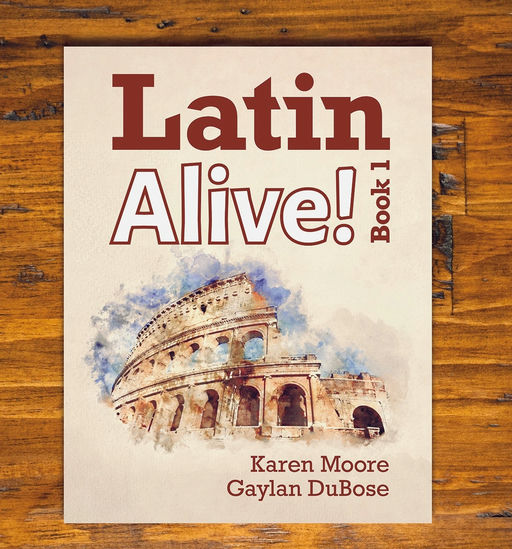
Required Materials: Books and supplies are not included in the purchase of the course. These resources are listed to help inform your decision-making as you make course selections and build your course schedule. Please reach out to the instructor if you have any questions about materials.
The instructors will be adapting and augmenting the curriculum as they see best for the learning objectives of the course. Some vocabulary has been modified and the textbook readings adapted. Students should know that we will not be completing every exercise and reading available in the book in class. Additional materials provided by the instructors may include worksheets, games, and spoken Latin activities. As such, students should be prepared to regularly print PDF files supplied by their teacher well in advance of the class in which they will be used.

ejkotynski.scholeacademy@gmail.com
Edward Kotynski, Chair of Latin Department, grew up as a missionary kid in Indonesia, where his parents were Bible translators. He attributes his love of languages partly to his parents’ work and his childhood experience. He received his BA in ancient languages from Wheaton College in Illinois in 2004, and his MA in classical languages from Vanderbilt University in Tennessee in 2007. Mr. Kotynski has been teaching Latin and Greek for the last fifteen years, mostly at classical Christian schools. He loves sharing his passion for the ancient languages with his students, weaving in historical context and modern connections. He has edited two volumes of Latin Alive! for Classical Academic Press and has also been working on their Greek for Children series with Erin Valdez. He is very excited to be continuing with Scholé Academy this year. Besides Latin and Greek, Mr. Kotynski drinks coffee, loves reading, helps homeschool his kids, and plays board games. He lives with his wife, six children, and two cats, enjoying the craziness of life together.

magisterbenson.scholeacademy@gmail.com
Tyrone Benson loves language and studied classical languages throughout his undergraduate and graduate careers. He holds a B.A. in Bible and Educational Ministry (double major), an M.A. in Christian Education, and an M.A. in Theology. While in Bible college, before graduating summa cum laude as the valedictorian of his class, he relished four semesters of Biblical Greek, received the distinguished Greek award, and served as lead campus tutor of Biblical Greek. Afterwards, while engaging the classical theological disciplines as a seminary student, he studied further Biblical Greek and Biblical Hebrew, then naturally transitioned into the study and teaching of classical Latin. A lifelong student of various disciplines even as a magister “teacher,” Mgr. Benson ever remains a discipulus (“student"). Mgr. Benson focuses his current studies on the Latin language, particularly its spinal role within a classical liberal arts curriculum, linking language(s) to history, literature, and theology. For six years, he has been using the Latin texts of Classical Academic Press to teach this subject he loves. Students find in Mgr. Benson, along with appreciation for plainness, a subtle, sophisticated sense of humor: such as sudden and surprising allusions to the works of Tolkien, both really relevant to the lesson and rather regular (i.e., in the majority of class sessions). Above all, he seeks to instill in all his students a love of learning in general and a love of language in particular.

Amanda Reeves has a BA in Greek and Latin from Stanford University, where she received recognition in her department for both her enthusiasm for the classical world as well as her excellence in scholarship. In her 10+ years as an educator, she has fiercely held to the belief that every student can fall in love with Latin and has celebrated each of the many times it has happened in her classroom. As Dean of the Lower School at Scholé, she supports teachers as they develop classrooms and curricula to help Scholé’s youngest students cultivate a love of learning in their pursuit of restful classical education. Having learned Latin online as a homeschooled student, Amanda is passionate about distance learning and enjoys integrating traditional grammar and translation methods with spoken Latin to produce the best educational experience for her students. When she is not traveling the world, she can be found in New Haven, Connecticut, waxing poetic about the Parthenon Marbles and Stanford football, always with a strong cup of coffee in hand.
First, read the available course descriptions, noting prerequisites, target grades, and course objectives. If you think your student is prepared for the course, go ahead and register. After registration, a placement assessment may be provided to students, depending on the course and the student’s previous enrollment with Scholé Academy. Registration is finalized when the student’s placement assessment has been returned by the course instructor with placement confirmation.
Make sure they don’t conflict with other activities in your schedule or other courses you are purchasing. Our system will not catch double-bookings!
Our Assistant to the Principal will be in touch with you after your enrollment to help you with next steps, including any placement evaluations that may be required for your course selections.
This registration will be finalized when the student’s placement assessment has been returned by the course instructor with placement confirmation.
This course is designed for students who have successfully completed Scholé Academy’s Latin 1 course,...
This course is designed for students who have successfully completed Scholé Academy’s Latin 2 course,...
This course offers instruction in Latin grammar and reading, building on the foundation laid in Latin 1, 2, and 3....