Loading enrollment options…
If sections and pricing don’t appear, email [email protected] and we’ll help you enroll.
Placement Process One critical factor for restful learning is the proper placement of students. If you are unsure which level is the best fit for your student, reach out to the instructor you are considering. Once registered, anticipate contact regarding placement evaluations from instructors by May 15th and throughout the summer. Students must be enrolled to enter the placement process. Early placement exams may allow time for tutoring or additional review based on the outcomes. See more about placement evaluations in our Student-Parent Handbook.
Math Placement Process For registered students, please anticipate contact regarding placement evaluations from instructors by May 15th and throughout the summer. Students must be enrolled in a math course to receive a placement assessment. Math classes have a detailed and specific placement process. Learn more about the math placement process
Watch the math placement process video with our department chair, Dr. Fransell Riley.
See the Math Scope and Sequence.
Calculus, at its core, considers and answers two questions:
Prior to calculus students are asked questions like “Given a car’s position at two different times, what was the car’s average speed between those times?” Derivative calculus asks questions like “What is the speed of the car at exactly 5 seconds from the moment it first began to accelerate given a position function in miles (d) as a function of time in seconds (t)?”
Prior to calculus students are asked questions like “During a sale, a business makes an average of profit per hour of $720. How much profit will it make in 5 hours?”
Integral calculus asks questions like, “What is the total profit (P) during the first 5 hours of a sale given a function H(t) that represents thousands of dollars of profit per hour as a function of time in hours (t) since the start of the sale?”
Calculus enables people to solve many real-world problems. Developing proficiency in calculus enables people to serve God, help people, and become employed in many rewarding fields of work.
This course prepares students to do well on an AP Calculus AB Exam and/or be deeply prepared to succeed in a college Calc 1 course.
Experience Calculus is built on a foundation of algebra, geometry, and trigonometry. Those skills will be relied on, built upon, and honed. The most frequent method is a Socratic-style discussion that the entire class participates in. A discussion takes place that reveals the relevance of this truth in our mathematical studies or our daily lives (real-life application). Lessons are presented through questions, problem-solving, and proof. The students have a puzzle or idea that they want to explore. As we delve deeper into answering the question at hand, we begin to discover the new mathematical concept. We discuss questions and problems in order to understand them and creatively and systematically problem-solve. We develop proofs in calculus as a way to construct understanding so that our application of theorems is not built on memorization alone but on deep conceptual understanding.
Methodology Students continue to study the new truth and deepen their understanding of it via homework, classwork, projects, and assessments. Since our classes do not meet 5 days per week, students must spend time studying the concepts outside of class. This also helps students grow in their ability to think and work math concepts independently which is required for future math classes. For this reason, we ask that students not use resources that answer problems for them. Doing so undercuts learning and will not lead to proficiency or the competency necessary to pass an AP Calculus AB exam. If a student receives an A on an assignment, it should be a true indication of their independent ability as the teacher interprets this A as independent mastery.
Assignments or classroom review activities are utilized to assist students with opportunities to retain or improve their mastery. Assessments are directly or indirectly cumulative and serve as an opportunity to deepen their learning. Assessments are not meant to be a regurgitation of previous homework assignments.
Preparedness Students who are adequately prepared to take this course will have mastered (can work independently without prompting):
Additionally, students who are adequately prepared to take this course will have the following commitments:
Required Materials: Books and supplies are not included in the purchase of the course. These resources are listed to help inform your decision-making as you make course selections and build your course schedule. Please reach out to the instructor if you have any questions about materials.
Required materials:
Sections with Eric Robinson
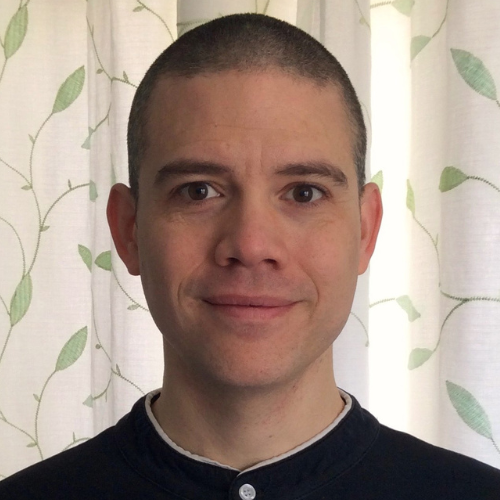
Eric Robinson has a MFA (Master of Fine Arts) degree in printmaking from Iowa State University and a BS in secondary math education from Western Governors University. Eric and his wife homeschool, so he has taught math from number recognition through Calculus 2. Having taught in private Christian (protestant and Catholic) schools and in public schools as well as tutoring in person and online, he is excited to teach courses in the Great Hall of Scholé Academy so that learning can be the true focus.
Eric was attracted to Scholé Academy for the commitment to restful learning. Eric loves the beauty of mathematical reasoning. He loves the feeling of accomplishment and confidence that comes from learning math. He loves the lightbulb moments, and he loves the real skills math builds--skills that make so many things doable and possible.
Eric also loves the Word of God. God is a God of truth and order, and so we find in scripture truth and logical arguments that help us to understand creation--God, ourselves, one another, redemptive history, and our hope in Christ Jesus. Eric loves sharing the Word of God to start every course session. Eric does that for the same reason he learns and teaches math: because doing so enriches us and helps us to discover the truths God has made. As Proverbs 25:2 says, "It is the glory of God to conceal a matter, but the glory of kings is to search out a matter."
First, read the available course descriptions, noting prerequisites, target grades, and course objectives. If you think your student is prepared for the course, go ahead and register. After registration, a placement assessment may be provided to students, depending on the course and the student’s previous enrollment with Scholé Academy. Registration is finalized when the student’s placement assessment has been returned by the course instructor with placement confirmation.
Make sure they don’t conflict with other activities in your schedule or other courses you are purchasing. Our system will not catch double-bookings!
Our Assistant to the Principal will be in touch with you after your enrollment to help you with next steps, including any placement evaluations that may be required for your course selections.
This registration will be finalized when the student’s placement assessment has been returned by the course instructor with placement confirmation.
Algebra I serves as the foundation for all future mathematics and science courses. Students continue to study...
Algebra II builds on the foundation of Algebra 1 and Geometry. Topics include real and complex numbers, linear,...
Euclid's great textbook "The Elements," remains a masterpiece of geometry. In this 1-hour per week course, students...