
Loading enrollment options…
If sections and pricing don’t appear, email [email protected] and we’ll help you enroll.
Placement Process One critical factor for restful learning is the proper placement of students. If you are unsure which level is the best fit for your student, reach out to the instructor you are considering. Once registered, anticipate contact regarding placement evaluations from instructors by May 15th and throughout the summer. Students must be enrolled to enter the placement process. Early placement exams may allow time for tutoring or additional review based on the outcomes. See more about placement evaluations in our Student-Parent Handbook.
Writing and Rhetoric Placement Process For registered students, please anticipate contact regarding placement evaluations from instructors by May 15th and throughout the summer. Students must be enrolled in a Writing and Rhetoric course to receive a placement assessment. Learn more about the Writing and Rhetoric placement.
Inside the Writing & Rhetoric Program: A Scholé Academy Info Session
Students taking this course continue in the trajectory of the Writing & Rhetoric series using Book 7: Encomium & Vituperation and Book 8: Comparison.
During the first semester, students learn how to craft essays praising a virtue (an encomium) and blaming a vice (vituperation). They focus on the following skills: discerning the main idea; utilizing hyperbole and thesis; incorporating background and supportive detail, biography, and autobiography; noting the good and poor qualities present in a person or event; contrasting virtuous behavior and vice, and crafting effective conclusions that encourage readers either to emulate virtue or eschew vice.
After completing the first semester, students spend approximately six weeks focusing on a research paper unit. Students will learn the seven steps to writing their own research paper: selecting a topic, getting an overview of the topic, outlining the paper, rounding up sources, taking notes, organizing note cards and completing an outline, and writing the paper while avoiding plagiarism.
In the second semester, building on existing skills, students develop the art of comparison. They learn how to craft a comparative composition that sets two persons, events, ideas, texts, or objects side by side for assessment. In learning this art of comparison, students also study elements of critical analysis, assessment, and judgment.
After completion of this course, students are well on their way to becoming master writers and effective orators. For a closer look at the texts used in this course, please follow these links and click “Look Inside”: Book 7: Encomium & Vituperation and Book 8: Comparison.
High School Credit: This course is the equivalent of one high school credit in English composition.
Placement: Please read about our placement process in the Student Parent Handbook.
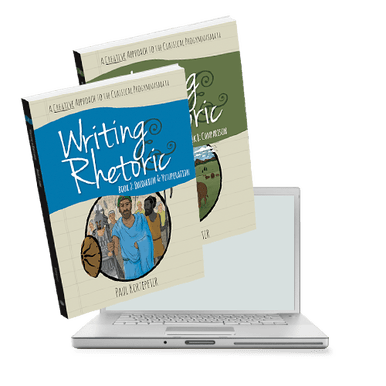
Required Materials: Books and supplies are not included in the purchase of the course. These resources are listed to help inform your decision-making as you make course selections and build your course schedule. Please reach out to the instructor if you have any questions about materials.
Optional Resources:
These audio files allow students to engage their sense of hearing and their listening intelligence as Greg Lowe delivers the readings aloud in a thoughtful manner. Commonplace Journal (This can be a spiral-bound notebook, bound journal, or loose-leaf notebook.)

Jillian Strecker has a BA in theology from Franciscan University of Steubenville, a MA in Russian literature from University College London, and has completed coursework in classical education from the University of Dallas. She is currently working on a doctorate in humanities from Faulkner University. Jillian has shared her passion for literature, writing, and poetry with children at private schools in New York City and New Orleans for over a decade. She is also a homeschool mom who has been educating her children for more than 15 years. Additionally, Jillian is a published poet whose book of children's poetry, Carousel Gardens, was a finalist in The William Faulkner Competition. She is currently working to get her book of poetry for adults published. When not teaching and writing, Jillian loves reading literature. Her favorite writers are Fyodor Dostoevsky, Ray Bradbury, H.G. Wells, Flannery O’ Connor, and Charles Dickens. She also loves riding her bike with her husband, baking, and watching the original Twilight Zone series with a large bowl of popcorn.

Amy Travis holds a BA in psychology and religious education with additional training in behavioral modification, counseling, and missions. She has lived in 4 countries outside the United States and studied multiple cultures and languages. She has been homeschooling her four children for over 20 years. She also has had the privilege of teaching adult ESL programs, high school history and literature courses, and middle school reading and grammar classes outside the home. On any given day, you will find Amy preparing lessons, conducting a new project with her children, experimenting with a creative meal for her family, or simply enjoying a restful time contemplating the goodness of God.

Nathan Dickinson, incoming Chair of the Canterbury House of Studies, holds a M.Div. from Southern Baptist Theological Seminary and currently serves as the planting priest of Church of the Good Shepherd in Summersville, West Virginia. He is a West Virginia native who has had approximately a decade of teaching experiences in local churches and missionary settings. He has taught the Bible in Kenya, Zambia, Myanmar, and Jamaica, and has taught English (among other things) to students in the Christian school setting. He loves helping students see the beauty of God in Holy Scripture and helping students learn to engage in meaningful dialogue.
His two boys (Barnabas and Martin) keep his home life interesting and full of adventure! When he is not adventuring with his wife and boys, he is looking for a good cup of coffee, a good book, and a good conversation.
Writing and Rhetoric: Book 7
Writing and Rhetoric: Book 7
Writing and Rhetoric: Book 8
(Note: The course map indicates overlap between the research paper unit and introducint the comparison writing unit. In part, this is because different instructors take different lengths of time on the research paper. In part, this is also because students may be completing final stages of the research paper unit as homework, while the comparison unit begins during class time.)
Writing and Rhetoric: Book 8
First, read the available course descriptions, noting prerequisites, target grades, and course objectives. If you think your student is prepared for the course, go ahead and register. After registration, a placement assessment may be provided to students, depending on the course and the student’s previous enrollment with Scholé Academy. Registration is finalized when the student’s placement assessment has been returned by the course instructor with placement confirmation.
Make sure they don’t conflict with other activities in your schedule or other courses you are purchasing. Our system will not catch double-bookings!
Our Assistant to the Principal will be in touch with you after your enrollment to help you with next steps, including any placement evaluations that may be required for your course selections.
This registration will be finalized when the student’s placement assessment has been returned by the course instructor with placement confirmation.
 St. Raphael School
The Advanced Novel Writing course invites students to take their creative writing to the next level through the...
This yearlong course is designed for aspiring writers in grades 7-9 who want to read, interpret, enjoy, and interact...
“The world does not need more Christian literature. What it needs is more Christians writing good...


