
Arithmetic is the first art of the quadrivium and the fourth of the seven liberal arts. As a liberal art, arithmetic is the study of number in itself: what numbers are, how they relate, and the patterns they reveal. It includes the practical skill of calculation, but it reaches further. The ancients studied arithmetic because number shows an order in the world that is true everywhere and always, and Christian teachers saw in that order the mind of the Creator.
For many families, math is the subject where classical education feels hardest to picture. Literature and history fit the great books naturally, but arithmetic can seem like a matter of worksheets and timed tests. This guide explains how the liberal arts tradition understood arithmetic, what kinds of number the ancients loved to study, and what a classical approach to math looks like at home and in a live online class.
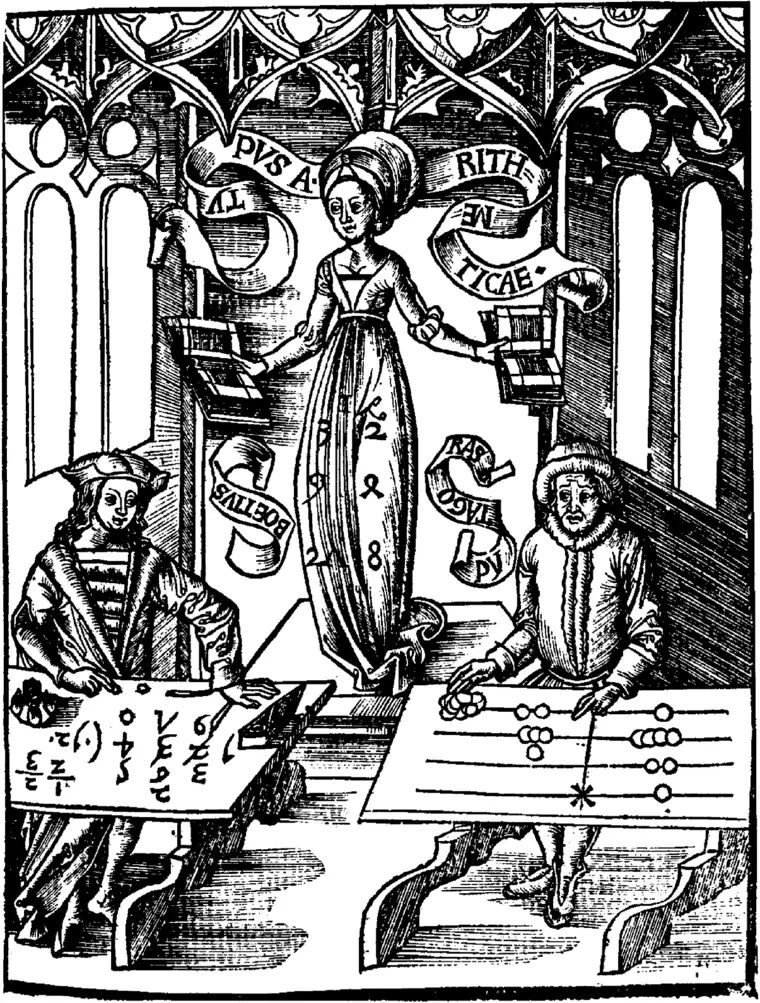
What is arithmetic as a liberal art?
Arithmetic, as a liberal art, is the study of number considered in itself: odd and even, prime and composite, ratio, proportion and the properties of particular numbers. The Greeks distinguished it from practical calculation, which they called logistic. Calculation serves trade and daily life; arithmetic contemplates the nature of number for its own sake.
Both belong in a child’s education. Children need fluent, accurate computation, and a classical math program insists on mastery. The liberal art adds wonder and understanding. A student who knows that 7 times 8 is 56 has a useful fact. A student who also notices why every even number is divisible by 2, or why the sum of two odd numbers is always even, has begun to think like a mathematician.
Why arithmetic comes first in the quadrivium
The four arts of the quadrivium all study quantity. Arithmetic studies number in itself, music studies number in relation, geometry studies magnitude at rest, and astronomy studies magnitude in motion. This division came from the Pythagoreans and was handed down through Nicomachus of Gerasa, whose Introduction to Arithmetic (around A.D. 100) became the standard ancient textbook. Nicomachus argued that arithmetic comes first because the other three depend on it. Take away number, and there is no ratio for music, no measurement for geometry and no counting of the heavens for astronomy.
Boethius adapted Nicomachus into Latin in the early sixth century, and his De institutione arithmetica taught arithmetic in the schools of Europe for nearly a thousand years. In its opening pages he used the word quadrivium, the “fourfold way,” for the four mathematical arts, the name they have carried ever since.
“Measure and number and weight”
Christian teachers found a theological reason to study number in Scripture: “thou hast ordered all things in measure and number and weight” (Wisdom 11:20). St. Augustine returned to that verse again and again. In On Free Choice of the Will, he pointed out that seven and three make ten, not only now but always, and for every mind that considers them. No one can make it otherwise. Such truths, Augustine argued, are unchangeable and common to all, and they point beyond themselves to the unchangeable Truth who is God.
That is a remarkable thing to say about a sum a first grader can learn. It means that arithmetic is one of the first places a child meets truth that does not depend on opinion, mood or power. Two and two make four for the king and the peasant alike. A math lesson, taught in that spirit, is a lesson in reality.
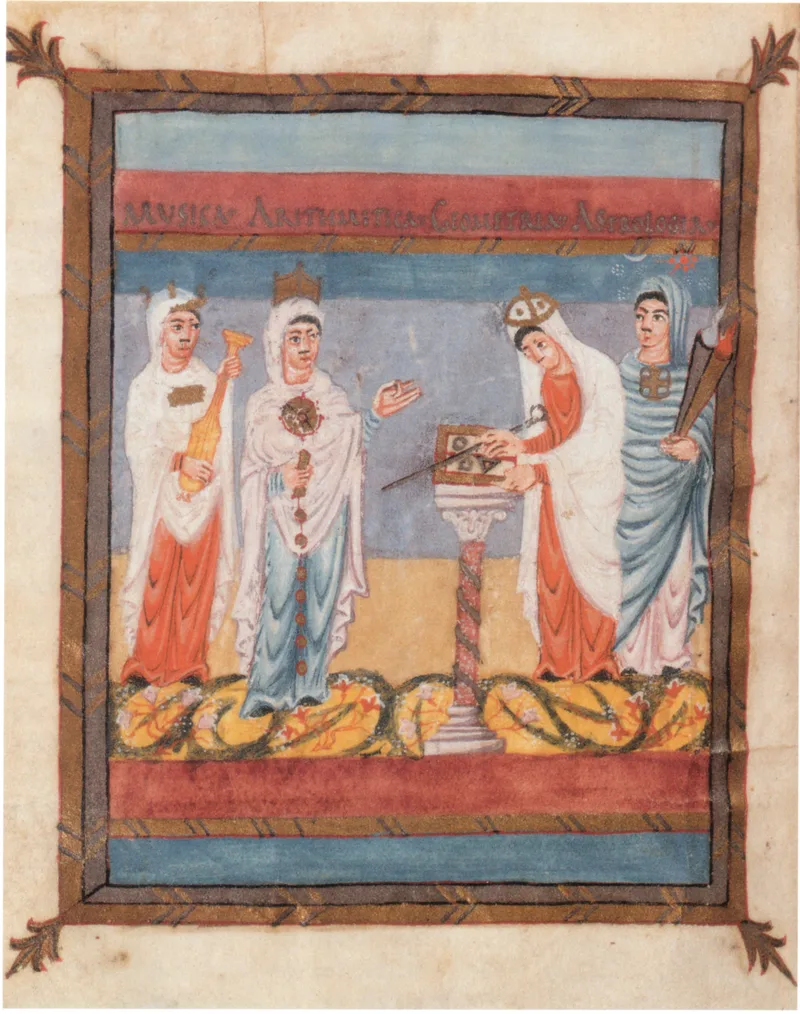
The kinds of number the ancients studied
Ancient arithmetic was full of delight. Nicomachus and Boethius classified numbers the way a naturalist classifies plants, and many of their discoveries are easy to share with children:
- Even and odd numbers, and the patterns that appear when they are added and multiplied.
- Prime and composite numbers, including the ancient method for finding primes known as the sieve of Eratosthenes.
- Perfect numbers, whose divisors add up to the number itself. Six is perfect (1 + 2 + 3), and so is 28 (1 + 2 + 4 + 7 + 14). Augustine noted that God made the world in six days, a perfect number.
- Figurate numbers, which can be arranged as shapes: triangular numbers (1, 3, 6, 10), square numbers (1, 4, 9, 16) and others.
- Ratio and proportion, the relations between numbers that later become the basis of music.
- The three means (arithmetic, geometric and harmonic), ways of finding a number that stands “between” two others.
A child who arranges pebbles into triangles and squares, or hunts for primes on a hundred chart, is doing what the Pythagoreans did. These explorations take little time and build exactly the number sense that makes later algebra feel natural.
What a classical approach to math looks like
A classical math education keeps both halves of arithmetic: the practical skill and the contemplative understanding. In practice that usually means:
- Mastery before speed. Facts are learned to fluency through steady practice, songs and games, then used constantly so they stay.
- Understanding before procedure. Students learn why an algorithm works, often with objects and drawings first.
- Explaining the reasoning. Students are asked to say or write how they know an answer is right, a habit described in Justify Your Answer.
- Patience in the sequence. Each step is built on a sure foundation, so students are not rushed into abstraction before they are ready.
- Room for wonder. Number patterns, puzzles and the history of mathematics are part of the lesson, not extras.
Scholé Academy’s teachers have set out their own approach in guiding principles for math education, which explains how students are placed and why a strong foundation matters more than an early start.

Arithmetic and the formation of virtue
Arithmetic trains honesty. An answer is right or wrong, and a student learns to check work, admit an error and try again. It trains patience, since some problems yield only to steady effort. It also trains a sense of proportion, which the ancients connected to temperance: the soul, like a well-made ratio, is healthy when each part has its fitting measure. That connection is explored in Temperance and Harmony.
Most of all, arithmetic can train gratitude. A child who sees that the world is full of order, that number works the same on Monday as on Saturday and in every country on earth, has reason to give thanks to the one who ordered it.
Arithmetic at Scholé Academy
Scholé Academy offers live online math courses from the early grades through calculus. Younger students build fluency and understanding in the Math Foundations sequence, and older students continue through pre-algebra, algebra, geometry and beyond. Families of younger children can see the full picture on the lower school page. The course catalog lists every math class and its placement guidance.
For the bigger picture of how arithmetic fits with the other six arts, see the guide to the seven liberal arts.
Frequently asked questions
What is arithmetic in the quadrivium?
In the quadrivium, arithmetic is the study of number in itself: its kinds, properties and relations. It comes first among the four mathematical arts because music, geometry and astronomy all depend on number.
How is liberal arts arithmetic different from math facts?
Math facts are the practical side of arithmetic, which the Greeks called calculation. The liberal art also studies why numbers behave as they do, such as what makes a number prime or perfect. A classical education teaches both.
What is a classical approach to math?
A classical approach to math emphasizes mastery, understanding before procedure, clear explanation of reasoning, and wonder at the order of number. It treats math as a way of knowing truth, not only as a set of skills.
Why did Christians study arithmetic?
Christian teachers saw number as part of the order God built into creation, citing Wisdom 11:20: “thou hast ordered all things in measure and number and weight.” Augustine taught that unchanging mathematical truths point toward the unchanging truth of God.
Arithmetic studies number in itself. The next art, geometry, carries number into space, and it is the subject of the next guide in this series.