
Writing and Rhetoric 1
Placement Information
Placement Process
One critical factor for restful learning is the proper placement of students. If you are unsure which level is the best fit for your student, reach out to the instructor you are considering. Once registered, anticipate contact regarding placement evaluations from instructors by May 15th and throughout the summer. Students must be enrolled to enter the placement process. Early placement exams may allow time for tutoring or additional review based on the outcomes. See more about placement evaluations in our Student-Parent Handbook.
Writing and Rhetoric Placement Process
For registered students, please anticipate contact regarding placement evaluations from instructors by May 15th and throughout the summer. Students must be enrolled in a Writing and Rhetoric course to receive a placement assessment.
Learn more about the Writing and Rhetoric placement.
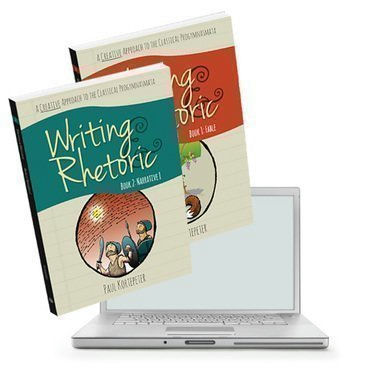
Required Materials:
Books and supplies are not included in the purchase of the course. These resources are listed to help inform your decision-making as you make course selections and build your course schedule. Please reach out to the instructor if you have any questions about materials.
- Writing & Rhetoric Book 1: Fable (Student Edition)
- ISBN: 978-1-60051-216-2
- Writing & Rhetoric Book 2: Narrative I (Student Edition)
- ISBN: 978-1-60051-218-6
Optional Resources:
- Writing & Rhetoric Book 1: Fable Audio Files
- Writing & Rhetoric Book 2: Narrative I Audio Files
- Spiral-bound notebook, bound journal, or loose-leaf notebook
These audio files allow students to engage their sense of hearing and their listening intelligence as Dr. Christopher Perrin, along with the Writing & Rhetoric series editor, Christine Perrin, deliver the fables, parables, and myths aloud in a thoughtful manner.
.png?cache=false)
Mrs. Amy Travis
[email protected]Amy Travis holds a BA in psychology and religious education with additional training in behavioral modification, counseling, and missions. She has lived in 4 countries outside the United States and studied multiple cultures and languages. She has been homeschooling her four children for over 20 years. She also has had the privilege of teaching adult ESL programs, high school history and literature courses, and middle school reading and grammar classes outside the home. On any given day, you will find Amy preparing lessons, conducting a new project with her children, experimenting with a creative meal for her family, or simply enjoying a restful time contemplating the goodness of God.
.png?cache=false)
Miss Kara Lobley
[email protected]Kara Lobley enjoys finding answers and imparting those discoveries to everyone. This passion for truth inspired her to earn her bachelor’s degree in history at Patrick Henry College (PHC), in Purcellville, VA. The classical experience at PHC and her own experience being homeschooled outside the classical tradition (K-12) showed Kara the beauties of each approach. She delights in witnessing how classical homeschooling equips students to identify and discover “the true, the good, and the beautiful” in the world around them and to share those breakthroughs with others.
Kara began working with children as a high schooler at children’s theater camps and at her church’s Vacation Bible Schools. During college and post-graduation, she spent five years as a high school writing tutor and one year as a preschool teaching assistant. Kara starting teaching lower and middle school Well-Ordered Language and Writing and Rhetoric classes with Scholé Academy in the fall of 2020 and is excited to return again this year. Outside of the classroom, Kara can be found reading, hiking, or singing.
.png?cache=false)
Mrs. Melissa Browne
[email protected]Melissa Browne holds a Bachelor of Arts in Anthropology from the University of Waterloo, Ontario, and is certified TESL Instructor. She taught privately as an English teacher in China, Taiwan, and in Peru for 10 years where she also studied Waldorf pedagogy. She is currently a brick-and-mortar Classical Elementary school teacher in Peterborough, Ontario where she teaches grade 3/4 with Classical Academic Press' Latin, Writing, and Grammar curriculum. In the afternoons, she tutors students in Latin, writing, grammar, spelling, Spanish, Singapore Math, and literature studies. Melissa also teaches Sunday school at her local church and periodically teaches ESL with the local college and university. Her students, both online and in-person, are an incredible encouragement and blessing.
Long Canadian winters find her enjoying board games and books, while summers are spent swimming at the beach and tending her garden. Hospitality and shared meals are a year-round joy. Melissa lives in Lakefield, Ontario, with her husband and two children, and makes occasional trips to Peru. She enjoys traveling, reading, and cooking, and delights in serving the body of Christ alongside her husband while watching their boys grow into godly young men.

Mrs. Rebekah Furubotten
[email protected]Rebekah Furubotten holds a Bachelor of Arts degree in English with a Creative Writing emphasis from Western Washington University and is a lover of literature, beauty, and the story of Jesus. As a seasoned instructor of Writing & Rhetoric 1, she seeks to display God’s Truth, Beauty, Goodness and Imagination through the course curriculum, introducing fable and the art of the written word.
Gathering friends to talk about books is one of her favorite things in the world, especially when the story is filled with gorgeous imagery, interesting characters, and artful writing. Loving their neighbors is an integral part of her family’s weekly rhythms, and you can find Rebekah hosting book clubs and parties for children and adults where they can discuss stories, ask good questions, and deepen their understanding of what they read and what makes good writing, good. Rebekah lives in Olympia, WA with her husband, four kids, and two dogs. When she isn’t teaching, chauffeuring, or reading, Rebekah enjoys making memories with her family, writing, cooking, hiking in the woods, and redecorating her house.
Quarter 1
Writing and Rhetoric Book 1: Fable
- What are Fables?
- What are Summary and Amplification?
- What is the Role of Anthropomorphism in Fables?
- Why is elocution important to storytelling?
Quarter 2
Writing and Rhetoric Book 1: Fable
- Exercises with Copiousness.
- Practice Summarizing Stories.
- Amplify Stories.
- Identify the Moral of a Story.
- Write Your Own Fable.
Quarter 3
Writing and Rhetoric Book 2: Narrative I
- Types of Narratives.
- What is a Parable?
- How does Point of View Affect a Story?
- Identifying the Main Idea in a Text.
- Amplification with Dialogue.
Quarter 4
Writing and Rhetoric Book 2: Narrative I
- Using Description to make a story more interesting.
- Combining Dialogue and Description.
- How does conflict help keep the reader’s attention?
- Write your own Narrative Conflict (Beginning and end of the story provided)
 Computer: You will
need a stable, reliable computer, running with a processor with a speed of 1 GHz or better
on one of the following operating systems: Mac OS X with Mac OS 10.7 or later; Windows 8,
7, Vista (with SP1 or later), or XP (with SP3 or later). We do not recommend using an
iPad or other tablet for joining classes. An inexpensive laptop or netbook would be much
better solutions, as they enable you to plug an Ethernet cable directly into your computer.
Please note that Chromebooks are allowed but not preferred, as they do not support certain
features of the Zoom video conference software such as breakout sessions and annotation,
which may be used by our teachers for class activities.
Computer: You will
need a stable, reliable computer, running with a processor with a speed of 1 GHz or better
on one of the following operating systems: Mac OS X with Mac OS 10.7 or later; Windows 8,
7, Vista (with SP1 or later), or XP (with SP3 or later). We do not recommend using an
iPad or other tablet for joining classes. An inexpensive laptop or netbook would be much
better solutions, as they enable you to plug an Ethernet cable directly into your computer.
Please note that Chromebooks are allowed but not preferred, as they do not support certain
features of the Zoom video conference software such as breakout sessions and annotation,
which may be used by our teachers for class activities.
High-Speed Internet Connection:
You will also need access to high-speed Internet, preferably accessible via Ethernet
cable right into your computer. Using Wi-Fi may work, but will not guarantee you the optimal
use of your bandwidth. The faster your Internet, the better. We recommend using a connection
with a download/upload speed of 5/1 Mbps or better. You can test your Internet connection here.
Webcam: You may
use an external webcam or one that is built in to the computer. Webcam Recommendations:
Good (PC only) | Best (Mac and PC)
Headset: We recommend
using a headset rather than a built-in microphone and speakers. Using a headset reduces the
level of background noise heard by the entire class. Headset Recommendations: USB | 3.5mm
Zoom: We use a web
conferencing software called Zoom for our classes, which enables students and teachers to
gather from around the globe face to face in real time. Zoom is free to download and easy
to use.  To
download Zoom:
To
download Zoom:
- Visit zoom.us/download.
- Click to download the first option listed, Zoom Client for Meetings.
- Open and run the installer on your computer.
- In August, students will be provided with instructions and a link for joining their particular class.
Scanner: In this
class, students frequently submit homework assignments by scanning pages from their workbooks.
Students and/or their parents should have easy access to a scanner and the ability to use it.
Step 1
Step 2
Step 3
Step 4
Explore our courses!
First, read the available course descriptions, noting prerequisites, target grades, and course objectives. If you think your student is prepared for the course, go ahead and register. After registration, a placement assessment may be provided to students, depending on the course and the student's previous enrollment with Scholé Academy. Registration is finalized when the student's placement assessment has been returned by the course instructor with placement confirmation.
All Courses | By Grade
Read the Student-Parent Handbook.
Please take careful note of our teaching philosophy, our technology requirements, our school policies, the parent agreement, and the distinctions between our grade levels.
Double-check the course section dates and times.
Make sure they don't conflict with other activities in your schedule or other courses you are purchasing. Our system will not catch double-bookings!
You're ready to add course selections to your cart!
Our Assistant to the Principal will be in touch with you after your enrollment to help you with next steps, including any placement evaluations that may be required for your course selections.
This registration will be finalized when the student's placement assessment has been returned by the course instructor with placement confirmation.