
Writing and Rhetoric 5
Placement Information
Placement Process
One critical factor for restful learning is the proper placement of students. If you are unsure which level is the best fit for your student, reach out to the instructor you are considering. Once registered, anticipate contact regarding placement evaluations from instructors by May 15th and throughout the summer. Students must be enrolled to enter the placement process. Early placement exams may allow time for tutoring or additional review based on the outcomes. See more about placement evaluations in our Student-Parent Handbook.
Writing and Rhetoric Placement Process
For registered students, please anticipate contact regarding placement evaluations from instructors by May 15th and throughout the summer. Students must be enrolled in a Writing and Rhetoric course to receive a placement assessment.
Learn more about the Writing and Rhetoric placement.
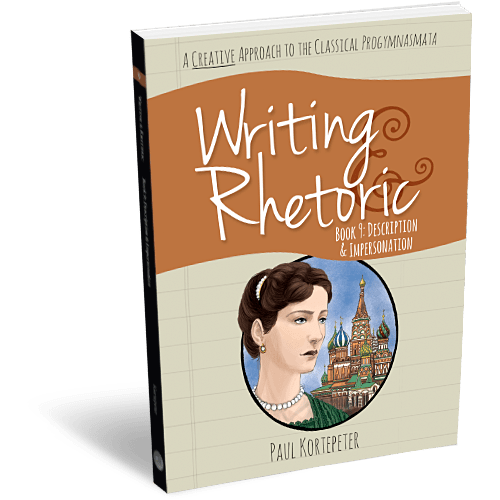
Required Materials:
Books and supplies are not included in the purchase of the course. These resources are listed to help inform your decision-making as you make course selections and build your course schedule. Please reach out to the instructor if you have any questions about materials.
- Writing & Rhetoric Book 9: Description & Impersonation (Student Edition)
- Writing & Rhetoric Book 10: Thesis Part 1 Writing & Rhetoric Book 10: Thesis Part 1 (Student Edition)
Optional Resources:
These audio files allow students to engage their sense of hearing and their listening intelligence as Greg Lowe delivers the readings aloud in a thoughtful manner.

Mrs. Amy Morgan
[email protected]Amy Morgan is Scholé Academy’s Writing & Rhetoric and Well-Ordered Language Department chair. She earned her BA in liberal arts at St. John’s College in Annapolis, Maryland, and continued her education with an MA in TESOL/applied linguistics at Indiana University in Bloomington. For over 20 years, Amy has taught English to speakers of other languages in university, community, and private contexts. Additionally, Amy educated her own children at home in grades PreK–8. When Amy’s not teaching, you might find her serving families and children in vulnerable circumstances, hosting international guests, or taking a walk at a nearby state park.

Miss Bella Welch
[email protected]Bella Welch holds a Bachelor of Arts in English with a minor in Early Childhood Education from Hillsdale College. Over the past four years, she has worked primarily with preschool and early elementary students in a variety of educational settings, including classical, Montessori, and Waldorf schools, as well as special education programs.
Bella is passionate about the beauty and depth of the English language and is dedicated to sharing that enthusiasm with others—whether through exploring great literature, strengthening writing skills, or analyzing sentence structure to better understand an author’s intent. As a former homeschool student and Scholé Academy alumna, Bella strongly believes in the ability to create rich, engaging learning environments beyond a traditional brick-and-mortar classroom.
Outside of teaching, Bella enjoys trail running, playing the cello, engaging in spirited games of Risk with friends or family, and, of course, getting lost in a good book.

Mrs. Vixie Friedman
[email protected]Since she was a little girl, Vixie Friedman always wanted to be a teacher and lined up her dolls and stuffed animals to compose her classroom. That dream became a reality when she began homeschooling her oldest son in 1988, a journey that continued with her six children until her youngest graduated from their family’s homeschool in 2015.
Vixie has taught in a formal classical education setting since 2008 and assisted with curriculum development and staff training with a classical Christian curriculum company. Classical education continues to be her passion as she observes her students blossom and develop their discussion skills while discussing history and/or literature through Socratic discussions and Socratic Circles.
After graduating with a BS degree in nursing from Western Carolina University, Vixie entered the US Army Nurse Corps, where she was stationed in Frankfurt, Germany. This fueled her love of travel and history as she married and left her Army commission to raise a family. She and her husband lived in Germany for nine years and enjoyed traveling throughout Europe, studying the region’s history as they traveled.
These days she continues to travel as she and her husband travel to Israel, Europe, and Africa through their ministry to the Jewish people, Children of Jacob.
She is continuing her education as she takes classes in classical education, history,literature, Russian, and German and enjoys enriching her education through Bible studies, personal reading, traveling, and book clubs. She enjoys spending time with her friends and family, including a growing number of grandchildren, cooking, gardening, and a multitude of crafts.
Quarter 1
Writing & Rhetoric Book 9: Description & Impersonation
- Description
Quarter 2
Writing & Rhetoric Book 9: Description & Impersonation
- Impersonation
Quarter 3
Writing & Rhetoric Book 10: Thesis Part 1
- Gathering and developing tools for thesis essays
- Begin first thesis essay.
Quarter 4
Writing & Rhetoric Book 10: Thesis Part 1
- Compose thesis essays
 Computer: You will
need a stable, reliable computer, running with a processor with a speed of 1 GHz or better
on one of the following operating systems: Mac OS X with Mac OS 10.7 or later; Windows 8,
7, Vista (with SP1 or later), or XP (with SP3 or later). We do not recommend using an
iPad or other tablet for joining classes. An inexpensive laptop or netbook would be much
better solutions, as they enable you to plug an Ethernet cable directly into your computer.
Please note that Chromebooks are allowed but not preferred, as they do not support certain
features of the Zoom video conference software such as breakout sessions and annotation,
which may be used by our teachers for class activities.
Computer: You will
need a stable, reliable computer, running with a processor with a speed of 1 GHz or better
on one of the following operating systems: Mac OS X with Mac OS 10.7 or later; Windows 8,
7, Vista (with SP1 or later), or XP (with SP3 or later). We do not recommend using an
iPad or other tablet for joining classes. An inexpensive laptop or netbook would be much
better solutions, as they enable you to plug an Ethernet cable directly into your computer.
Please note that Chromebooks are allowed but not preferred, as they do not support certain
features of the Zoom video conference software such as breakout sessions and annotation,
which may be used by our teachers for class activities.
High-Speed Internet Connection:
You will also need access to high-speed Internet, preferably accessible via Ethernet
cable right into your computer. Using Wi-Fi may work, but will not guarantee you the optimal
use of your bandwidth. The faster your Internet, the better. We recommend using a connection
with a download/upload speed of 5/1 Mbps or better. You can test your Internet connection here.
Webcam: You may
use an external webcam or one that is built in to the computer. Webcam Recommendations:
Good (PC only) | Best (Mac and PC)
Headset: We recommend
using a headset rather than a built-in microphone and speakers. Using a headset reduces the
level of background noise heard by the entire class. Headset Recommendations: USB | 3.5mm
Zoom: We use a web
conferencing software called Zoom for our classes, which enables students and teachers to
gather from around the globe face to face in real time. Zoom is free to download and easy
to use.  To
download Zoom:
To
download Zoom:
- Visit zoom.us/download.
- Click to download the first option listed, Zoom Client for Meetings.
- Open and run the installer on your computer.
- In August, students will be provided with instructions and a link for joining their particular class.
Scanner: In this
class, students frequently submit homework assignments by scanning pages from their workbooks.
Students and/or their parents should have easy access to a scanner and the ability to use it.
Step 1
Step 2
Step 3
Step 4
Explore our courses!
First, read the available course descriptions, noting prerequisites, target grades, and course objectives. If you think your student is prepared for the course, go ahead and register. After registration, a placement assessment may be provided to students, depending on the course and the student's previous enrollment with Scholé Academy. Registration is finalized when the student's placement assessment has been returned by the course instructor with placement confirmation.
All Courses | By Grade
Read the Student-Parent Handbook.
Please take careful note of our teaching philosophy, our technology requirements, our school policies, the parent agreement, and the distinctions between our grade levels.
Double-check the course section dates and times.
Make sure they don't conflict with other activities in your schedule or other courses you are purchasing. Our system will not catch double-bookings!
You're ready to add course selections to your cart!
Our Assistant to the Principal will be in touch with you after your enrollment to help you with next steps, including any placement evaluations that may be required for your course selections.
This registration will be finalized when the student's placement assessment has been returned by the course instructor with placement confirmation.