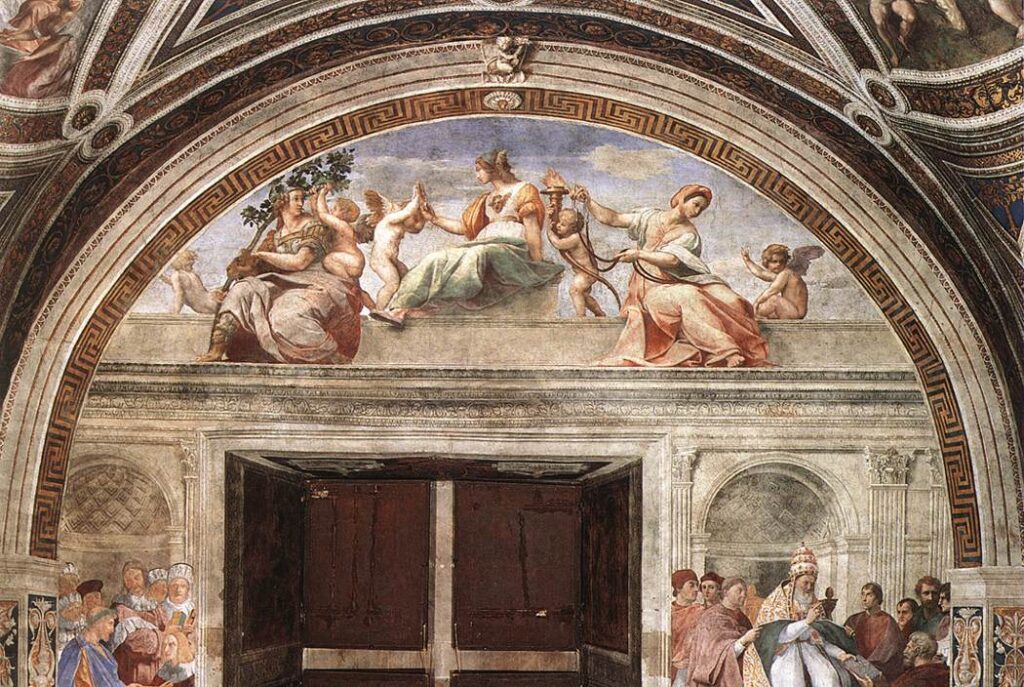

Painting: Wisdom and Prudence by Francesco Rustici, 1610–1625
To be prudent in the bible is to exercise right judgment, to see reality as it truly is and to act accordingly. This is far more than common sense or practical shrewdness. The biblical definition of prudence reaches toward something deeper: the perfection of reason, or the perfection of the natural capacity of the soul to see reality as it is.
More than just a view of the physical reality around and about us, prudence sees the spiritual and relational reality that underlies it. Another way to describe prudence is discernment. A prudent person can discern what ideas and acts conform to reality and which do not. But prudence is more than an ability to see or assess. It is also the ability to act upon these assessments.[1] Thus, a prudent person discerns what is a right act and acts upon it.
This is not merely utilitarianism, because it does not see reality as isolated bits and pieces, but as a whole and, in the Christian sense, under the rubric of God’s revealed word in scripture. As a result, prudence is discernment and action in conformity to reality as it is revealed in creation and in scripture.
A Word Worth Reclaiming
Prudence is not a word most of us grew up with. Contemporary education largely discarded the traditional vocabulary of the virtues, and what remained of “prudence” in common speech was its pejorative offspring: the prude, the one too dried and cautious for the reckless fun of the moment. But the prude, for all the schoolyard scorn heaped upon him, was the one who remembered that choices have consequences, that principals and parents and even the Lord God Almighty would have to be reckoned with. Beneath the mockery was a person practicing the very thing our souls long for: a calm self-control that does not shrivel with age but deepens into wisdom.
The word prudence is worthy of our usage, yet it must be used with understanding. Not the schoolyard taunts of childhood, but the dawning of tradition on a mind opening with humility as it ages. What does prudent mean in the bible? It means far more than caution. It means seeing clearly, judging rightly, and acting in love. It even shapes the way we practice prudence in writing, where discernment meets expression.
Prudence and Charity: A Vital Distinction
But prudence is not charity. Charity is the motivation for all good Christian acts. Prudence is the deliberative, judicial, and decisive means by which charity manifests itself. Therefore, charity motivates every portion of the prudential process. Only because we are motivated by love of God can we sense that we must deliberate, decide what to do, and act upon that decision. Yet charity does not take the place of prudence but undergirds it. We need prudence to properly make decisions that are loving towards God and man.
Understanding what prudence means in the bible requires us to hold these two realities together: the warmth of charity as our motivation, and the clarity of prudence as our means.
Prudence is also, in its practice, a means of joy, peace, and contentment. This is because things done well do not so often backfire, and at least our consciences are not smeared. The prudent life is not the pinched life. It is the life that has learned to cooperate with God’s own providence, and in that cooperation finds the deep gladness that recklessness can never deliver.
Prudence Is Not Casuistry
Prudence is also not the same as casuistry. That is, it does not imagine every situation ahead of time and assign a rightness to it in advance, for we cannot conceive of every possibility, and it would take away from our present duty to do so.[2] Instead, prudence relies upon the situation at hand to determine the rightness of an act.
How, then, does prudence avoid relativism or, more properly, subjectivism? First of all, though every situation is different, the underlying reality is objective. This means that though there may be an infinite variety of acts that are produced through prudence, these are a small subset of the infinite variety of acts that could otherwise be produced. Reality limits the kinds of decisions that can be made in any situation.
The Biblical Foundation of Prudent Decision-Making
The reality described is not just the reality of the physical world around us, but the reality described in scripture. Therefore, the general laws of God limit the variety of responses that can obtain in any given moment. For example, “thou shalt not steal” remains a moral reality to which prudence must conform.[3]
Thus Pieper says, “Thomas [Aquinas, with regard to] the performance of man’s proper duties to be just (in which category falls his obedience to the laws of Church and State), remarks that these in particular are most independent of changes in situations and are therefore most likely to be fixed once and for all.”[4] Therefore, situational relativism is a vast domain, but is clearly limited. Learning what those boundaries are is why one must become familiar with scripture, the physical world, and the people in it.
Prudentia: The Etymology of Foresight
The word prudentia means, at its root, a kind of foresight or practical wisdom. Our English word “prudence” comes from the Latin prudentia, itself an alteration of providentia: pro meaning “ahead” and videre meaning “to see.” The word we think of as caution, wisdom, or good judgment has as its core foresight, the ability to see ahead. The prudent, provident person is the one who, foreseeing the outcome, chooses not for the present, short-term gain, but for the future, long-term reward. The prudent person provides “provisions” for the pilgrimage to paradise, personally knowing the path.
When we define prudence in the bible, we find this same forward-looking quality: the prudent person in Proverbs sees danger and takes refuge, while the simple pass on and suffer for it (Proverbs 22:3). Biblical prudence is not timidity but a readiness of soul, a practiced capacity to perceive what is real and to respond rightly.
This foresight extends not only through the affairs of daily life but into eternity itself. Prudence, in its fullest biblical meaning, means looking ahead beyond the pale existence we call life to the consummation of creation, and letting all of our choices propel us toward the summit of God’s mercy. Our growth in prudence is merely the fruit of our roots growing ever deeper in God’s bottomless providence. With the remembrance of death, we keep our minds fixed on the empty grave of our Savior, so that we can focus our choices and bend our will beyond this fleeting life into eternity.
When the Situation Is Unclear
What becomes difficult is when one encounters situations not mentioned in scripture or the teaching of the church. This is where prudence particularly outshines casuistry: casuistry is limited by the number of scenarios one has imagined ahead of time and is mechanical, but prudence is a virtue of the heart.
In regards to man’s duties as well as in these more subjective cases, however, we need humility to give attention especially to three things: 1) the word of God, 2) outside expertise, and 3) prayer. We must read the word of God regularly so as to instill in our minds and hearts what the realities of our world are (both physical and spiritual). Where needed, consulting others with an expertise or with experience in a particular area may be necessary; we need the humility to trust the knowledge and abilities of others. Finally, prayer is a prerequisite for Christian prudence. Without prayer there can be no objective vision of reality. God is the only one who has an objective “birds’ eye” view of reality. He not only can grant supernatural wisdom to us, but can influence outcomes.
Why Prudence Is the Mother of All Moral Virtues
As with all virtues, however, it must be emphasized that prudence is a goal to pursue and not an achievement to be had. One becomes able to make prudent decisions quickly only through practice.[5] Without expertise or practice, there is a gap in one’s knowledge of the situation and prudent decision-making is rendered impossible.
Prudence also is different from the other cardinal virtues in that it is not an end, but a means. One must be prudent to pursue justice, fortitude, and temperance. Without prudence these other three cannot come into existence no matter how many other requisite characteristics are present. In this sense prudence is the mother of all moral virtues. It is the virtue that makes all other virtues possible, the quiet foundation upon which the entire edifice of the moral life is built.
This is why the classical tradition has always placed the formation of prudence at the center of education. A student who learns to read carefully, to weigh arguments, to attend to what is true before deciding what to do, is a student being formed in prudence, whether the lesson is Latin grammar, Euclidean geometry, or the Gospel of John. This formation happens through teaching virtues in the classical Christian liberal arts classroom, and even through the stories we give our children, as children’s literature itself forms virtue in ways that no lecture alone can accomplish.
With these thoughts reframing our minds and stirring our souls, let us lift our voices with the Psalmist (89/90:12):
So teach us to number our days,
That we may gain a heart of wisdom.
May we all grow in prudence and all the virtues by our collaboration with our Loving Lord.
Forming Prudent Students Through Classical Education
If prudence is the mother of all virtues, then the question for every parent is not only what their child will study, but how that study will form the soul. Classical education, at its best, is an education in prudent discernment: learning to see reality clearly, to deliberate carefully, and to act in conformity with what is true and good.
At Scholé Academy, this is the heart of every course we offer. Our live, online classes in theology, philosophy, literature, Latin, logic, and the liberal arts are designed not merely to transmit information but to cultivate the habits of mind and heart that make prudent decision-making possible. In small, discussion-driven classrooms, students practice the very skills that prudence demands: close reading of scripture and the great texts, careful reasoning, attentive listening, and the humility to learn from teachers and fellow students alike. If you are seeking an education that forms your child in wisdom and virtue, we invite you to explore our full course catalog and discover what restful, classical learning looks like.
- (action according to reason = κατὰ λόγον) ↩
- Matthew 6:34 and 10:19. ↩
- G.K. Chesterton’s fictional character Father Brown, in The Blue Cross, has the following conversation with the thief Flambeau:
Flambeau: ‘[W]ho can look at those millions of worlds [in the night sky] and not feel that there may well be wonderful universes above us where reason is utterly unreasonable?’
Brown: ‘No’ said the other priest; ‘reason is always reasonable.’
Flambeau: ‘Yet who knows if in that infinite universe—?’
Brown: ‘Only infinite physically,’ said the little priest, turning sharply in his seat, ‘not infinite in the sense of escaping from the laws of truth.’
- (The Four Cardinal Virtues. Notre Dame Press, 1966: pp. 25–26) ↩
- This is where casuistry may be helpful in training the habits, as long as it does not replace a prayerful attitude and a proper appreciation for the situation at hand. ↩