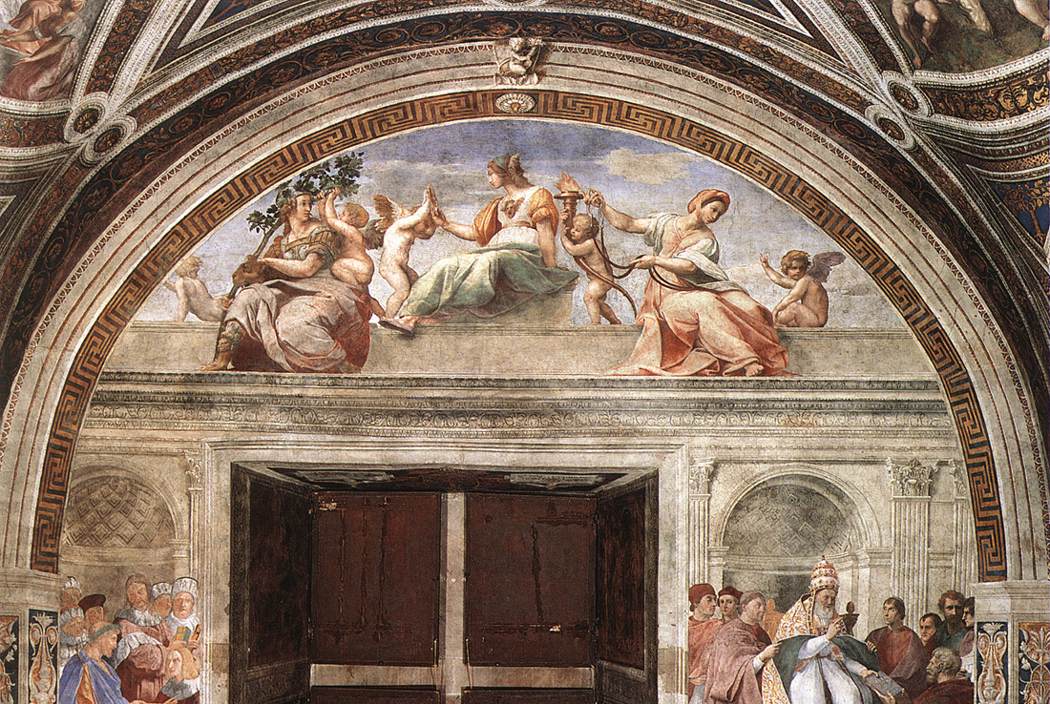
Painting: The Cardinal and Theological Virtues by Raphael, 1511, Stanza della Segnatura, Vatican
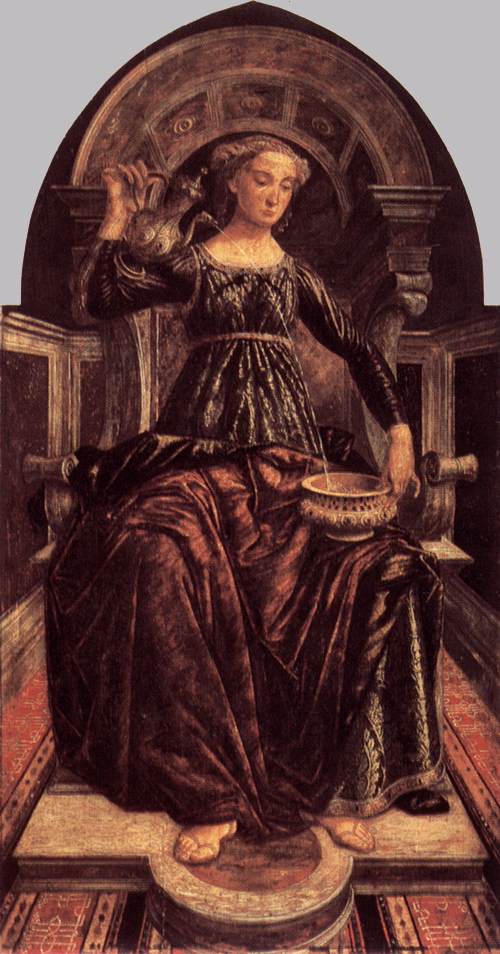
Temperance is the virtue that brings order and harmony to the whole person. The classical and Christian tradition counts it among the four cardinal virtues, alongside prudence, justice, and fortitude, and it has never meant by it a grim habit of saying no. The temperance virtue, rightly understood, is the fitting together of desires, appetites, habits, and loves, so that each part serves the good of the whole. A temperate soul is not a smaller soul. It is a soul in tune.
Modern life tends to fragment the self into separate spheres. Each part is analyzed on its own merits, often without being joined back to the whole, and those analyses are then used to offer simple solutions to deep problems. Analysis is good, but it does not bear fruit without synthesis. A liberal arts education in the classical model offers a much-needed corrective to that fragmentation. It teaches students to see themselves, and all of reality, as a harmonious whole.
In this post
- What Is the Virtue of Temperance?
- Temperance and Harmony in the Classical Tradition
- Temperance in the Bible
- Why Temperance Matters in Classical Education
- Examples of Temperance in a Classical Classroom
- Frequently Asked Questions About Temperance
- Forming Temperate Students Through Classical Education
What Is the Virtue of Temperance?
The virtue of temperance is the settled habit of ordering our desires and pleasures by right reason, so that each finds its proper place in a life directed toward God. The Catechism of the Catholic Church describes it as the virtue that “moderates the attraction of pleasures and provides balance in the use of created goods” (CCC 1809).
The Latin word behind it is telling. The philosopher Josef Pieper, in The Four Cardinal Virtues, notes that the verb temperare means at its root “to dispose various parts into one ordered whole.” Mixing wine with water, tuning the strings of a lyre, and blending colors on a palette are all kinds of tempering. This is why temperance and harmony belong together. Moderation is the visible sign of temperance, but harmony is its substance.
The Greeks called the same virtue sophrosyne, a word built from “sound” or “whole” and “mind.” It names a soundness of soul, the inner health of a person whose parts are at peace with one another. Eastern Christian writers took up the word and filled it with new depth, as an earlier post on sophrosyne from an Orthodox Christian perspective explores.
Temperance and Harmony in the Classical Tradition
In Book IV of the Republic, Plato says that temperance is more like a concord or harmony than any of the other virtues. Wisdom and courage live in one part of the city, but temperance runs through the whole of it, so that the stronger and the weaker parts agree about which ought to lead. Plato then turns the image inward. In the temperate soul, reason, spirit, and appetite are friends rather than rivals, and the two that are ruled agree that reason should rule. The parts sound together instead of against one another.

Pieper adds an observation that can seem puzzling at first. Prudence, justice, and fortitude all look outward: to reality, to the neighbor, to danger. Temperance alone turns first toward the self. That might make it look self-absorbed, even at odds with its sister virtues. Pieper’s answer is that temperance is “selfless self-preservation.” The self is put in order, not for its own sake, but so that the whole person can be given to God and neighbor.
Moderation for its own sake, then, is not a virtue. The Christian’s goal is to love God without measure. The moderation of temperance orders the rest of life toward that end, and it does so as it is guided by prudence, the virtue of right judgment, and joined to justice and fortitude. When the cardinal virtues are seen together, and in light of the theological virtues of faith, hope, and love, the seeming paradox disappears.
Temperance in the Bible
Scripture seldom pauses to define temperance, but the virtue is everywhere in its pages. The King James Version names temperance among the fruit of the Spirit (Galatians 5:22-23), and St. Peter urges believers to add “to knowledge temperance; and to temperance patience” (2 Peter 1:6). St. Paul reminds the Corinthians that “every man that striveth for the mastery is temperate in all things” (1 Corinthians 9:25), and he tells Titus that the grace of God teaches us to “live soberly, righteously, and godly, in this present world” (Titus 2:12).
The Wisdom of Solomon, honored in the Orthodox, Catholic, and Anglican traditions alike, even names all four cardinal virtues together. Of divine Wisdom it says, “she teacheth temperance and prudence, justice and fortitude” (Wisdom 8:7).
Behind all of these stand the two great commandments: to love God with all the heart, soul, mind, and strength, and to love the neighbor as oneself (Mark 12:30-31). Love of that kind requires integration at every level of life. A longtime Scholé Academy Latin instructor once described these commandments as the lens through which to see all of life, and therefore all of education. In a classroom, that means a harmony of every part: choosing what is best from among many good things, seeing rightly the relative importance of each, and curbing excess.
Why Temperance Matters in Classical Education
The first step in bringing temperance into education is to consider what education is for. Its purpose is to bring children up in the ways of the Lord and to raise whole and healthy adults who love and serve other people. A liberal arts education, more specifically, aims to see the world as a unified whole. That whole includes every subject, but it also includes the whole person: body, mind, and spirit.
Latin offers a useful case study. Like many subjects, it can be taught in isolation from the rest of the curriculum. It can even become self-important, more so in classical schools than anywhere else. It can be reduced to a set of rules and words to be decoded because it is “good for its own sake.” An earlier post showed how the pieces of Latin fit together into one ordered whole once a student grasps the system of the language. Temperance asks the teacher to take the next step and see how the subject fits into everything else.
Humility helps here, and it is fitting that Thomas Aquinas places humility under temperance. A humble teacher does not ask Latin to be the whole of education. Latin is one way into history, language, and the thinking of God’s people in ages past, all of which help students see their own time and place more clearly. Language taught in a vacuum becomes vacuous. In context, the classical languages give students a vote in what G.K. Chesterton called “the democracy of the dead,” and, as C.S. Lewis argues in “On the Reading of Old Books,” they open ideas that are no longer fashionable, so that students can see past the blind spots of their own age.
Examples of Temperance in a Classical Classroom
The second step is action. Prudence supplies the knowledge, and humility supplies a sense of proportion. Temperance then keeps each subject in its proper relation to the others and to its proper ends. At Scholé Academy, Latin instructors teach more than the language. Students also discover Roman culture, history, philosophy, philology, agriculture, and more, because the aim is to form the whole person and not simply to cover a subject. Here are some examples of temperance as it shapes the upper school Latin program.

- A liturgical rhythm. Scholé Academy encourages liturgical teaching: traditions that welcome students as people, listen to their daily joys and sorrows, and pray with them. Students are greeted formally as class begins, and the class parts deliberately with a formal salutation at the end.
- A predictable week with room to breathe. A typical week moves from review of earlier material, to new vocabulary, grammar, and a weekly motto, to practice, to reading an excerpt or adaptation from Latin literature, and finally to an assessment that keeps students accountable and shows the teacher how each student is growing.
- Variety inside the order. That regularity is broken up with games, worksheets, reinforcement activities, and read-alouds. Time for discussion, and even for a rabbit trail, is built into the schedule. Classes talk about how Latin relates to English and other languages, how knowing Latin changes the way we read translated literature such as the Bible, where each week’s reading sits in Roman history, and how a poet builds a line.
- Joy. Just as importantly, Latin classes laugh together. A temperate classroom is not a joyless one.
- Truth spoken in love. Accuracy matters, and corrections are given, but they are given with charity. Temperance governs the tongue as well as the appetite, a theme explored in a tamed tongue as a type of temperance.
Every part of the classroom is meant to produce one unified whole, a single self that, in all its parts, moves together toward God and the good. Families who would like this kind of Latin classroom for an older student can browse the upper school courses.
Examples of Temperance at Home
Temperance is learned at the kitchen table long before it is studied in a book. A family meal where conversation has time to unfold, a reading hour without screens, one good book read slowly instead of five skimmed, and a Sunday kept for rest and worship are all small acts of tempering. Children learn from these that pleasure has a proper place, and that the proper place is usually a better one than the place appetite would choose.
Temperance in a Novel: In This House of Brede
Literature can show the virtue at work more vividly than a definition can. One of our instructors once spent a summer with Rumer Godden’s In This House of Brede, the story of Philippa Talbot, a successful London professional who leaves her career, her friends and a romantic attachment to enter a Benedictine abbey in England. Her friends cannot understand why anyone would give up so much. What Philippa is seeking is exactly what this post has been describing: an inner ordering and peace. The novel traces that ordering slowly and honestly. She sets aside her own preferences, accepts the small renunciations of the common life, and finds, in Godden’s words, that “the pulling up of her stakes, or claims, to her private loves, renouncing them,” had made room for a wider and less possessive love.
That is Pieper’s temperance in narrative form. The various parts of a life are disposed “into one unified and ordered whole,” and the result is the “serenity of spirit” that Aquinas calls quies animi. Philippa’s journey runs from pride toward humility, from curiositas toward studiositas, and it ends with a woman who knows the truth about herself, her Creator and her neighbors. Parents of older students will find the novel a rich companion to this virtue, and a reminder that temperance is not a cage but the shape of a soul at rest.
Frequently Asked Questions About Temperance
What is the virtue of temperance?
Temperance is the moral virtue that orders our desires and pleasures by right reason. In the classical tradition it is less about restriction than about harmony, the fitting together of every part of the person into one ordered whole directed toward God.
Is temperance a cardinal virtue?
Yes. Temperance is one of the four cardinal virtues, together with prudence, justice, and fortitude. The word “cardinal” comes from the Latin cardo, a hinge, because the rest of the moral life turns on these four.
What is an example of temperance?
A student who sets aside a phone to finish an assignment well, a teacher who keeps a beloved subject in its proper place within the whole curriculum, and a family that rests on the Lord’s Day are all examples of temperance. In each case a good thing is kept in its right proportion so that a greater good can flourish.
How can children grow in the virtue of temperance?
Children grow in temperance through steady habits, good examples, and an ordered daily rhythm, more than through lectures. Stories help too, since children’s literature forms virtue by letting young readers see self-mastery lived out.
Forming Temperate Students Through Classical Education
No teacher or parent has fully achieved this harmony. St. Paul’s words belong to all of us: “I have not achieved it, but I focus on this one thing: Forgetting the past and looking forward to what lies ahead, I press on” (Philippians 3:13-14, NLT). The work goes on “with fear and trembling” (Philippians 2:12, ESV), with the reminder that “with man this is impossible, but with God all things are possible” (Matthew 19:26, NIV).
Scholé Academy, part of Classical Academic Press, offers live, online classes in Latin, literature, theology, and the liberal arts, taught by instructors who care about the formation of the whole student. If you are looking for an education that forms your child in wisdom, temperance, and joy, we invite you to explore our course catalog.