
Grammar is the first of the seven liberal arts and the foundation of the trivium. As a liberal art, grammar means much more than diagramming sentences. It is the art of reading and writing a language well, and of receiving the stories, poems, histories and Scripture that the language carries. Every other art is learned through it, which is why the classical tradition teaches it first and never stops teaching it.
For homeschool parents, grammar is also the art most often misunderstood. It can sound like a dry list of rules, or like a “stage” a child passes through before moving on to more interesting things. The older tradition saw it as something richer: the patient work of taking in a language and a culture until both become part of the student. This guide explains what grammar meant to the ancients, why Latin became the classic grammar school language, what the “grammar stage” is, and what grammar looks like at a kitchen table today.
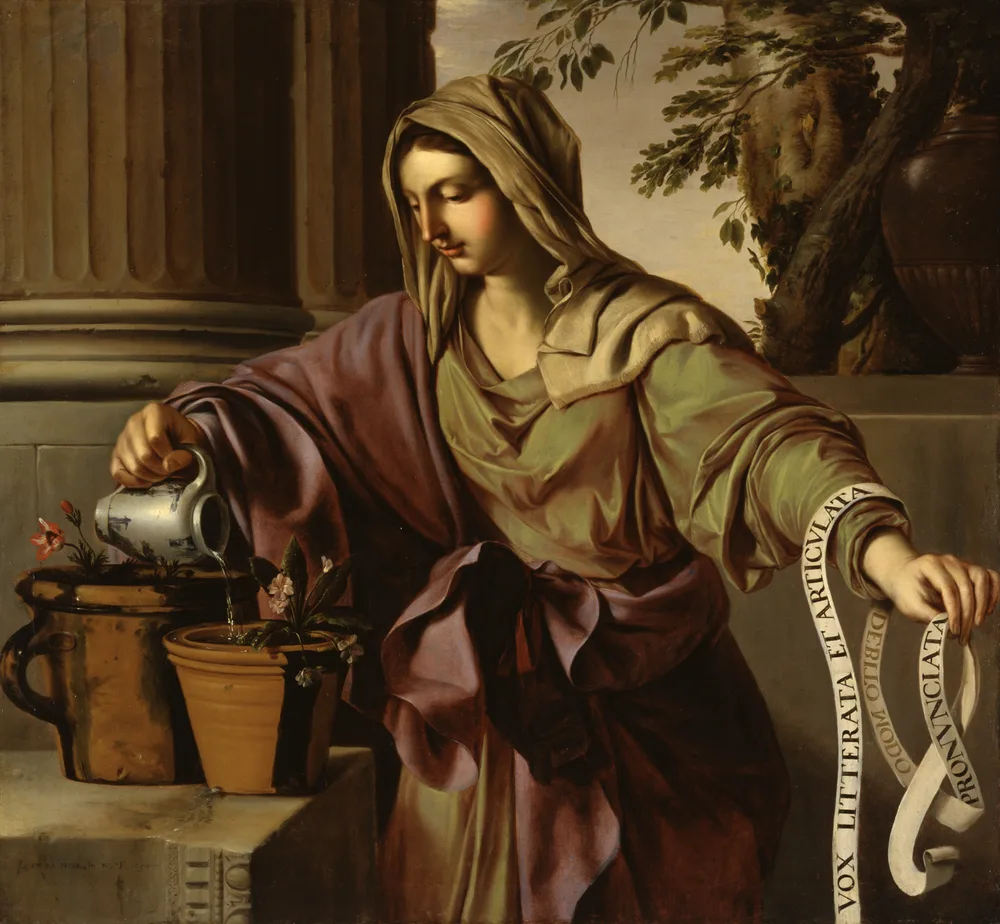
What is grammar as a liberal art?
Grammar, as a liberal art, is the art of using and understanding language rightly. It includes the rules of a language (its sounds, letters, forms and sentences) and the reading of its best writers. The Roman teacher Quintilian described it as the knowledge of correct speech together with the interpretation of the poets. Grammar receives; logic tests; rhetoric expresses.
That last sentence is the key to the trivium. Grammar asks, “What does this say?” It is an art of attention and reception. Before a student can judge an argument or make one, the student has to understand words, follow sentences and remember what has been read. The grammar of a language and the content of a culture are learned together, the way a child learns a mother tongue by hearing it spoken and sung.
Grammar in the ancient and medieval schools
The Greeks gave grammar its name, from gramma, a letter. Around 100 B.C., Dionysius Thrax wrote a short Art of Grammar that defined the subject as practical knowledge of how the poets and prose writers use language. His definition is telling. Grammar was never only the study of rules. It was the study of how good writers actually write, so that students could read them well and, in time, write like them.
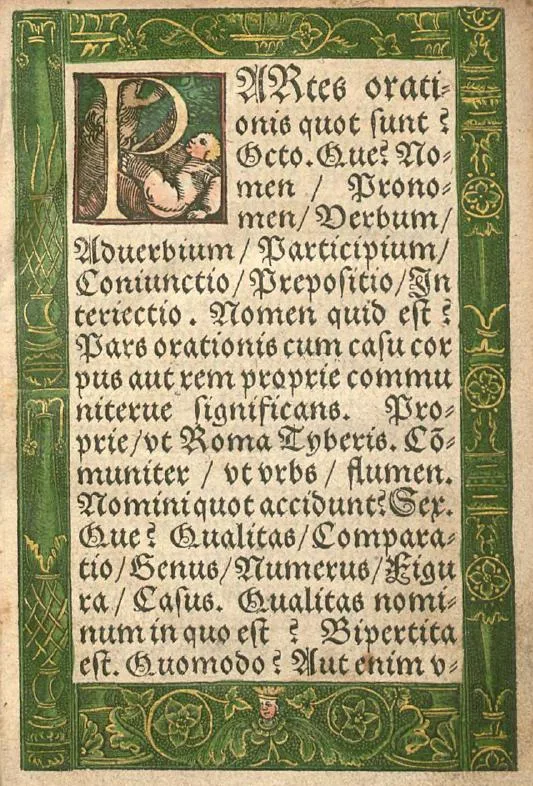
Roman schools followed the same pattern. The grammaticus taught boys to read aloud with correct pronunciation, to parse and explain difficult lines, and to memorize long passages of Virgil. Quintilian, writing in the first century, gave grammar two parts: the art of speaking correctly and the explanation of the poets (Institutio Oratoria 1.4). In the fourth century, Aelius Donatus wrote the Ars Minor, a little question-and-answer textbook on the eight parts of speech. It was used in schools for more than a thousand years, so widely that “a donat” came to mean a primer.
When Martianus Capella pictured the seven liberal arts as bridesmaids at a heavenly wedding, he made Grammar an elderly woman carrying a small case of tools, among them a knife and a file for trimming away children’s mistakes. The image is a little severe, but it holds a truth parents recognize. Grammar is corrective work, done patiently and early, so that the mind’s later work will be sound.
Why Latin became the classic grammar school language
For most of Western history, the “grammar school” was a Latin school. Latin was the language of the Church, of law, of learning and of the great books, so learning to read it opened the door to everything else. It also proved to be a superb teacher of language itself. Because Latin is highly inflected, every noun and verb wears its job on its sleeve, and a student who learns to read it must notice how words fit together. Many families find that English grammar becomes clear for the first time when their children meet it again in Latin.
Latin also gives students roughly half of the English vocabulary they will need for serious reading, and much of the vocabulary of science, medicine and law. More important, it brings them into conversation with Virgil, Augustine and the Latin hymns of the Church. This blog has explored the question of why study Latin at all and about the joy of learning to think in the language through the direct method.
The grammar stage: what Dorothy Sayers saw in young children
Many parents know grammar first through the idea of a “grammar stage.” It comes from Dorothy L. Sayers’ 1947 lecture “The Lost Tools of Learning,” in which she matched the arts of the trivium to the seasons of childhood. Younger children, she observed, love to memorize. They chant, collect, repeat and recite with real delight, often things they do not yet fully understand. Sayers called this the “Poll-Parrot” stage and argued that schools should fill it with things worth remembering: chants, rhymes, Latin forms, the names of the stars, the dates of history, the great stories.
The insight has helped thousands of families. Memory work in the early years is neither cruel nor mechanical when it is done with joy and with good material. A child who has memorized a psalm, a poem and the Latin noun endings at eight has furniture in the mind for a lifetime.
The stage idea works best when it stays an idea about emphasis. Grammar does not end at age ten. A high school student reading Homer in translation is still doing the work of grammar when she pays close attention to what the text actually says, and a first grader is already doing logic when he asks why. The tradition treats grammar as the first art and the lasting one.
What grammar looks like at home
Grammar in the classical sense is less a single subject than a way of approaching every subject in the early years. A grammar-rich day for a young child might include:
- Reading aloud from books worth hearing twice: fairy tales, myths, Bible stories, poetry and well-written history.
- Narration, in which the child tells back what was read, in order and in full sentences.
- Copywork and dictation, copying a beautiful sentence by hand, then writing it from dictation.
- Memory work, through songs, chants and recitation: Scripture, catechism, poems, Latin forms, math facts.
- Phonics and spelling, taught explicitly until reading is fluent and free.
- Parts of speech and sentence structure, learned in short, regular lessons and then noticed in real books.
- Latin, begun gently with vocabulary and chants and built into real grammar by the upper elementary years.
None of these takes long on a given day. Their power is in steady repetition across years. Other essays on this blog explore reclaiming the delight of learning to read and discovering the joy of language from the inside. Both make the same point: grammar is meant to be loved.

Grammar and the formation of virtue
Grammar trains habits of soul as well as habits of mind. It asks a child to attend closely, to receive before judging, and to submit to forms that were not invented yesterday. In that sense it is an education in humility: the student listens first. It also asks for perseverance. Declining a noun for the twentieth time or copying a sentence without a mistake is small, repeated faithfulness, the kind of steady courage described in The Glory of Fortitude in Grammar School.
The classical tradition also places grammar after something deeper. Before formal study comes wonder and piety: love for what is good and trust in those who teach it. Our essay on wonder and piety as the basis of a liberal arts education explores that root. Grammar grows best in that soil.
Grammar at Scholé Academy
Scholé Academy’s live online classes build the art of grammar steadily through the lower school and beyond. Younger students begin with reading and literature courses and with Latin for Children, while older students continue through Latin 1 to 5 and grammar courses that teach English sentence structure with care. Students can also begin Greek with a primer on the Greek alphabet and grammar.
Families can browse the full course catalog to find the right starting point for each child, or read the guide to all seven liberal arts to see where grammar leads.
Frequently asked questions
What is the grammar stage in classical education?
The grammar stage is the name many classical educators give to the early elementary years, when children memorize easily and enjoy chants, songs and stories. The idea comes from Dorothy Sayers’ 1947 essay “The Lost Tools of Learning.” In those years, teaching focuses on language, memory and rich content.
Is grammar just parts of speech?
No. In the liberal arts tradition, grammar includes the rules of a language and the close reading of its best writers. It is the art of understanding what a text says, which makes it the foundation for logic and rhetoric.
Why do classical schools teach Latin grammar?
Latin makes the structure of language unusually visible, supplies much of English vocabulary, and opens the great books and the Church’s tradition. Many students learn English grammar most clearly by studying Latin.
When does the grammar stage end?
The emphasis on grammar is strongest in the early elementary years, but the art itself never ends. Older students and adults keep using it whenever they read closely and pay attention to exactly what a text says.
The next art of the trivium, logic, asks what grammar alone cannot: whether what we have read is true. It is the subject of the next guide in this series.