Geometry is the second art of the quadrivium and the fifth of the seven liberal arts. For more than two thousand years, students learned it from one book: Euclid’s Elements. As a liberal art, geometry studies magnitude at rest (points, lines, angles and figures) and the proofs that connect them. It teaches a student that some things can be known with certainty, and it teaches the patience and honesty it takes to know them.
Many parents remember geometry as the high school course with two-column proofs and little explanation of why they mattered. The liberal arts tradition tells a different story. This guide explains what Euclid’s Elements is, why Plato and Lincoln valued geometry, how the subject points to the order of creation, and how families can begin geometry at home long before the first formal proof.
What is geometry as a liberal art?
Geometry, as a liberal art, is the study of magnitude at rest: the properties of points, lines, angles, surfaces and solids, and the demonstrations that prove them. Where arithmetic studies number, geometry studies shape and space. Its method is the proof, a chain of reasoning from clear definitions and self-evident starting points to conclusions that must be true.
That method is what made geometry a liberal art and not only a practical skill. Surveyors and builders used geometry in Egypt long before the Greeks. The Greeks asked a further question: not only how to measure a field, but how we know that our measurements must work. Their answer was the proof, and the greatest collection of proofs ever written is Euclid’s.
Euclid’s Elements: the textbook of two thousand years
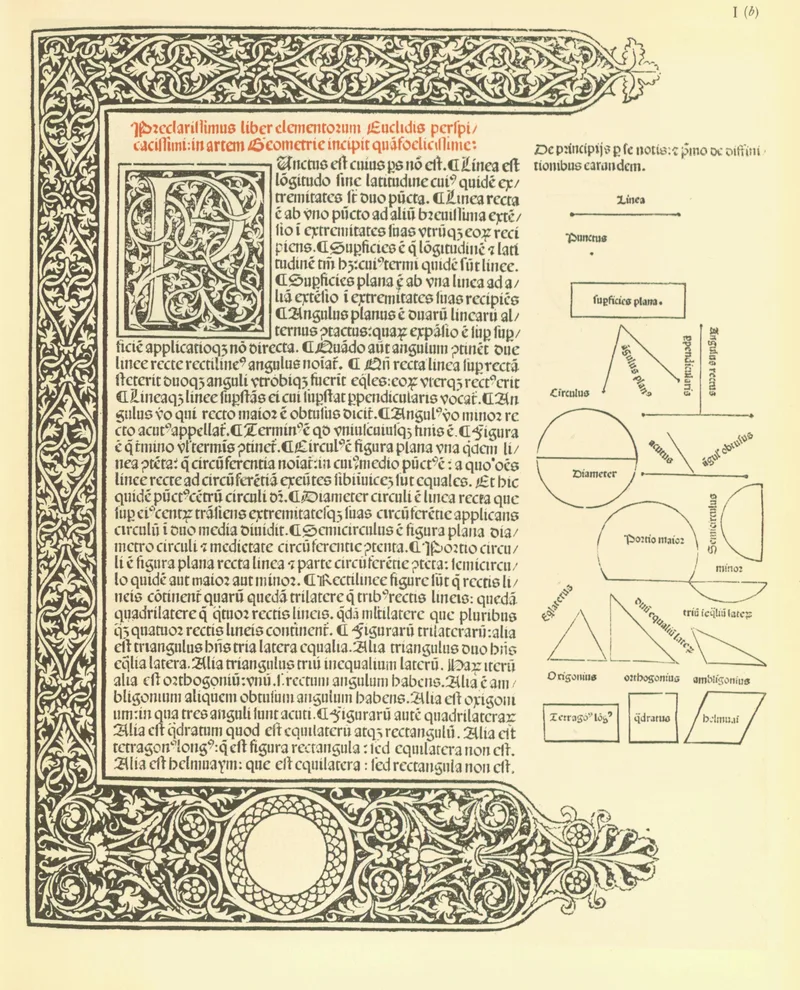
Euclid taught in Alexandria around 300 B.C. His Elements, in thirteen books, gathered the geometry and number theory of the Greek world into a single ordered system. It begins with 23 definitions, five postulates and a handful of common notions, such as “things which are equal to the same thing are also equal to one another.” From those few starting points it proves hundreds of propositions, each building on the ones before.
The first proposition shows how to construct an equilateral triangle on a given line with nothing but a compass and a straightedge. Proposition 47 of Book I is the Pythagorean theorem. Later books treat proportion, numbers, and the five regular solids. The Elements was copied, translated into Arabic and Latin, printed within decades of Gutenberg, and used as a school textbook into the twentieth century. Few books in history have shaped more minds.
A free English translation of the whole work is available in the online edition by David Joyce of Clark University, with diagrams students can explore.
Why study geometry?
According to a later tradition, the entrance to Plato’s Academy bore the words “Let no one ignorant of geometry enter.” Whether or not the inscription existed, it captures what Plato believed. In the Republic, he argued that geometry draws the soul toward truth, away from shifting appearances and toward what is always so. A triangle drawn in sand is imperfect, but the triangle the student reasons about is not.
Students today gain the same benefits:
- Certainty. A proof shows that a conclusion must be true, not merely that it seems likely. Students learn what it means to know something.
- Order. Each step rests on earlier ones. Students learn to build arguments that hold together.
- Honesty. A proof cannot be bluffed. Every step has to be justified, which trains intellectual integrity.
- Patience. Some propositions yield only after long attention, and students learn that understanding is worth waiting for.
- Beauty. Many students find, often to their surprise, that a good proof is beautiful.
Abraham Lincoln wrote in a short autobiography in 1860 that he had “studied and nearly mastered the Six-books of Euclid, since he was a member of Congress.” A lawyer and self-taught statesman, Lincoln wanted to understand what it means to demonstrate something, and he went to Euclid to find out. Many students since have found the same thing: geometry trains the mind for every kind of careful argument, in law, in science and in theology.
Geometry and the order of creation
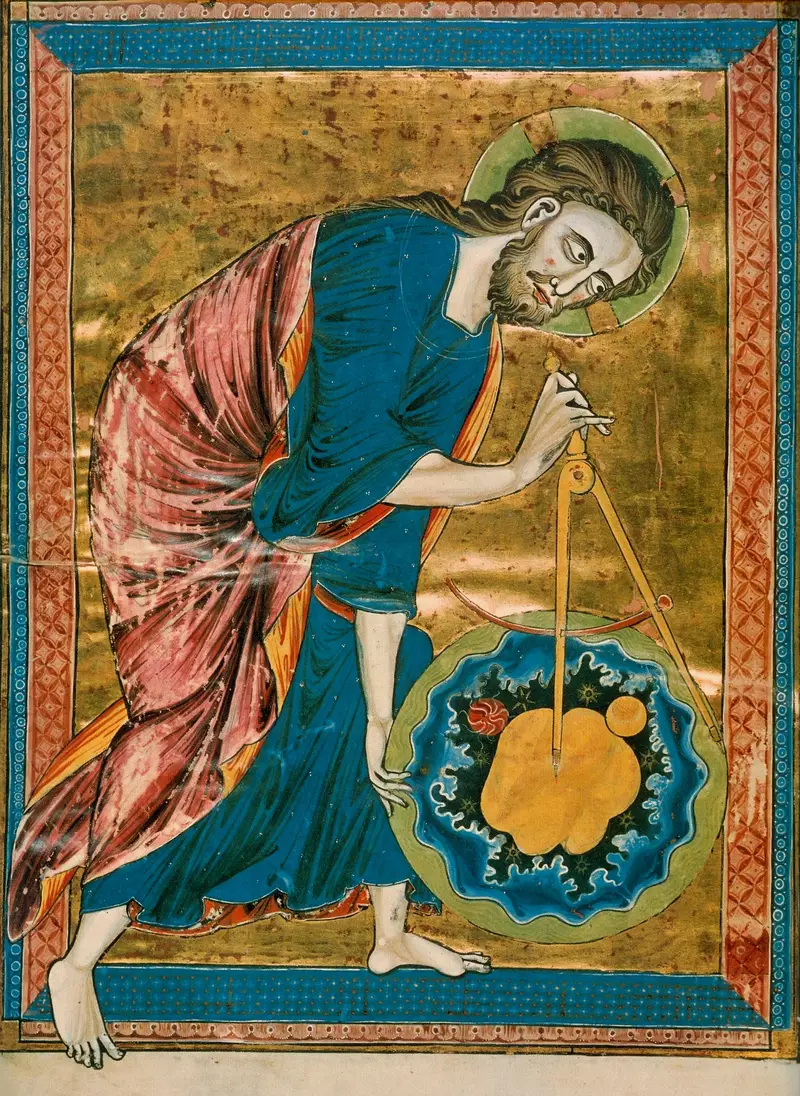
Christian teachers found in geometry a glimpse of the wisdom by which the world was made. Proverbs pictures divine Wisdom present at creation, “when he set a compass upon the face of the depth” (Proverbs 8:27), and medieval artists painted God as an architect measuring the world with compasses. Johannes Kepler, the astronomer who discovered the laws of planetary motion, believed that geometry was eternal in the mind of God and that studying it was a way of tracing the Creator’s thoughts.
The point is not that God is a mathematician in a narrow sense. It is that the world has a real order, accessible to reason, and that the order is good. A student who sees that the angles of every triangle add up to two right angles, wherever and whenever the triangle is drawn, has met a small piece of that order face to face. The courage such study can require is explored in Fortitude in Science.

Geometry at home, before the first proof
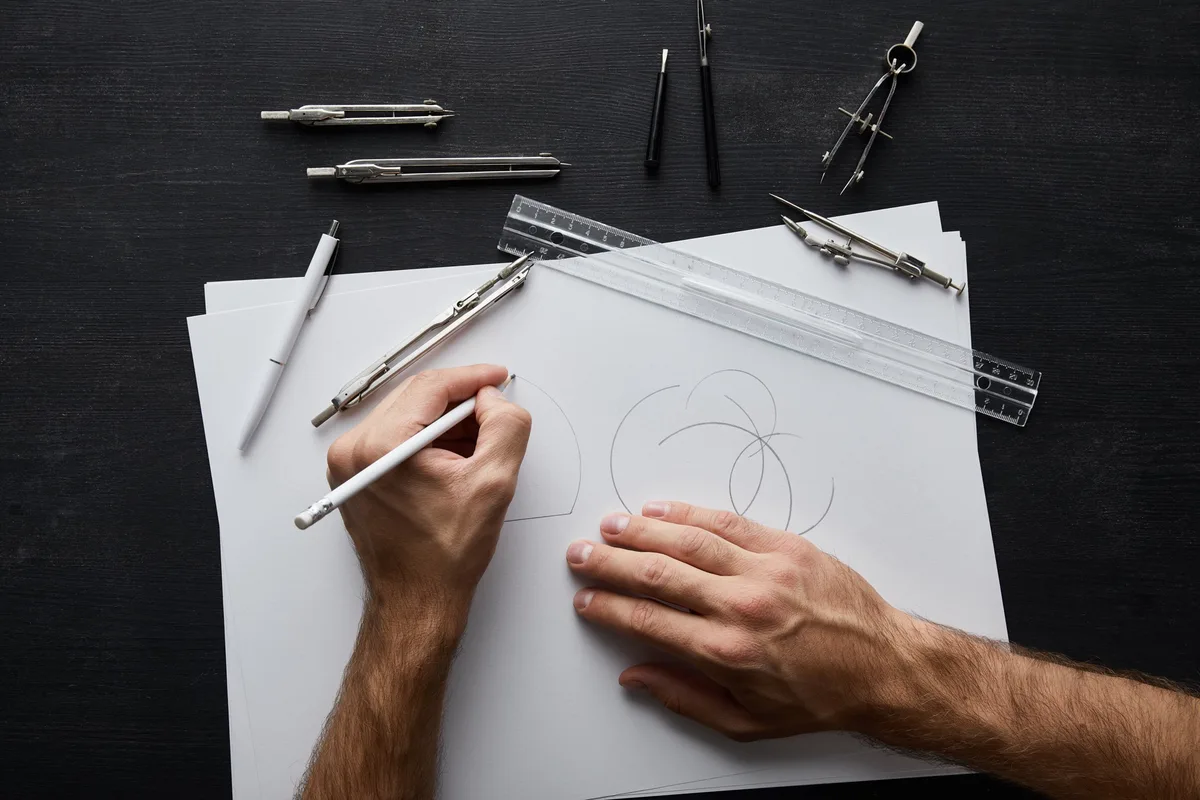
Children can begin geometry long before they write a proof. A compass, a straightedge and some paper are enough for years of discovery:
- Constructions. Draw a circle, then an equilateral triangle on a line, exactly as Euclid’s first proposition directs. Then bisect an angle and a line.
- Patterns. Draw overlapping circles to make the six-petaled rosette found in medieval windows and tiles.
- Shapes in the world. Look for triangles in bridges, hexagons in honeycombs and spirals in shells.
- Measuring. Measure the angles of several triangles and notice that they always add up to 180 degrees. Then ask why.
- Folding. Fold paper to find a square’s diagonals, a circle’s center and a triangle’s midpoints.
The habit of asking “why must this be true?” is the beginning of proof. A student who brings that habit to a formal geometry course is ready for Euclid. The same habit of explaining one’s reasoning is described in Justify Your Answer.
Geometry at Scholé Academy
Scholé Academy offers two paths into geometry, usually taken in the upper school years. The Geometry course covers high school geometry and its proofs. Euclidean Geometry reads the first six books of Euclid’s Elements itself, the same six books Lincoln studied.
Families can browse the course catalog for placement details, or return to the guide to the seven liberal arts to see how geometry fits among the other arts.
Frequently asked questions
What is Euclid’s Elements?
Euclid’s Elements is a mathematical work in thirteen books, written in Alexandria around 300 B.C. It builds plane geometry, proportion, number theory and solid geometry from a few definitions and postulates, and it was the standard geometry textbook for more than two thousand years.
Why study Euclid instead of a modern textbook?
Reading Euclid shows students geometry as a single connected argument, built step by step from first principles. Many students find that this makes proof clearer and more meaningful than a collection of separate rules.
Why is geometry one of the seven liberal arts?
Geometry trains the mind to reason from first principles to certain conclusions, and it reveals the order of the physical world. The ancients saw it as preparation for philosophy, and Christian teachers saw it as a way to see the wisdom in creation.
When should children start geometry?
Children can begin informally at any age with drawing, constructing and measuring shapes. Formal proof-based geometry usually comes in the high school years, after algebra.
Geometry studies shape at rest. The next art, music, studies number in relation and the harmony it creates. It is the subject of the next guide in this series.