Loading enrollment options…
If sections and pricing don’t appear, email support@scholeacademy.com and we’ll help you enroll.
Curiosity is natural to the young student, and wonder the natural habitat of early learners. This course seeks to direct that instinctual curiosity toward the learning of Ancient History in a creative, whole-child approach.
As children grow, perhaps one of the most important skills is that of reflection and remembrance, remembering where we have come from so we know where we are going and, in so doing, create a cultural memory of our lineage. This course seeks to do that as it returns to the roots of civilization in the ancient world. Archeology plays a significant role in the study of the ancient cultures. Students will visit the ancient civilizations of Sumeria, Mesopotamia, Egypt, and the Far East. They will gain a greater understanding of the timeline of History in considering where the differing civilizations rest. The story, culture, architecture, worldview, literature, and pantheon of a variety of kingdoms and civilizations are acquired. In addition, the student will gain skills in reading maps, timelines, and research.
Important Skills & Behaviors Needed for Success in this Course
Student Expectations: Executive Function Skills Students enrolling in Scholé Academy’s Ancient History for Middle Grades will be expected to show the development of Executive Function throughout the year. Executive Functioning is the brain’s work of planning, prioritizing, controlling impulses, recollection, etc. These six areas of execution are important in this class and, ultimately, in the student’s life.
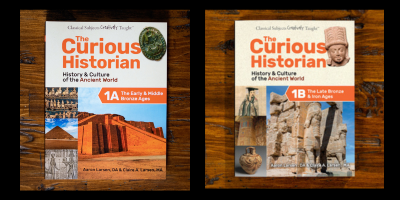
Required Materials: Books and supplies are not included in the purchase of the course. These resources are listed to help inform your decision-making as you make course selections and build your course schedule. Please reach out to the instructor if you have any questions about materials.
vixiefriedman.scholeacademy@gmail.com
Since she was a little girl, Vixie Friedman always wanted to be a teacher and lined up her dolls and stuffed animals to compose her classroom. That dream became a reality when she began homeschooling her oldest son in 1988, a journey that continued with her six children until her youngest graduated from their family’s homeschool in 2015.
Vixie has taught in a formal classical education setting since 2008 and assisted with curriculum development and staff training with a classical Christian curriculum company. Classical education continues to be her passion as she observes her students blossom and develop their discussion skills while discussing history and/or literature through Socratic discussions and Socratic Circles.
After graduating with a BS degree in nursing from Western Carolina University, Vixie entered the US Army Nurse Corps, where she was stationed in Frankfurt, Germany. This fueled her love of travel and history as she married and left her Army commission to raise a family. She and her husband lived in Germany for nine years and enjoyed traveling throughout Europe, studying the region’s history as they traveled.
These days she continues to travel as she and her husband travel to Israel, Europe, and Africa through their ministry to the Jewish people, Children of Jacob.
She is continuing her education as she takes classes in classical education, history,literature, Russian, and German and enjoys enriching her education through Bible studies, personal reading, traveling, and book clubs. She enjoys spending time with her friends and family, including a growing number of grandchildren, cooking, gardening, and a multitude of crafts.
lhartke.scholeacademy@gmail.com
Lauren Della Piazza Hartke is a third generation teacher, raised by parents who instilled in her a passion for history and literature. She graduated from a Christian high school before attending Geneva College in Beaver Falls, Pennsylvania. Lauren had the opportunity to study abroad in Scotland for a semester before obtaining a B.A. in History. As a teaching assistant at Geneva College she fell in love with teaching the humanities and accordingly went on to obtain an M.A. in Public History from Georgia Southern University where she also worked as a teaching assistant and a coordinator for the Ogeechee International History Film Festival.
Lauren’s abiding interest is in educating people of all ages in all matters of history, but her favorite eras are classical and medieval Europe. Her experience in both Christian and secular higher education made her consider her own pedagogy and preference for the classical model. She firmly believes that an education in the humanities enables us to better love God and love our neighbors.
Besides reading and watching old films, Lauren loves baking, traveling, playing the piano, and hiking. She and her husband Logan live in Jacksonville, Florida where they share a house with their cat, Katya. They love cooking for friends and family members, and can frequently be found at exotic grocery stores shopping for unique ingredients.
Quarter 1: Ancient Mesopotamia
Quarter 2: Ancient Egypt
Quarter 3: The Late Bronze Age, The Iron Age (Part 1)
Quarter 4: The Iron Age (Part 2), and The Far East
First, read the available course descriptions, noting prerequisites, target grades, and course objectives. If you think your student is prepared for the course, go ahead and register. After registration, a placement assessment may be provided to students, depending on the course and the student’s previous enrollment with Scholé Academy. Registration is finalized when the student’s placement assessment has been returned by the course instructor with placement confirmation.
Make sure they don’t conflict with other activities in your schedule or other courses you are purchasing. Our system will not catch double-bookings!
Our Assistant to the Principal will be in touch with you after your enrollment to help you with next steps, including any placement evaluations that may be required for your course selections.
This registration will be finalized when the student’s placement assessment has been returned by the course instructor with placement confirmation.
This course introduces high school students to some of the important historical texts of the 20th century and into the...
A Child’s History of America is a year-long survey course that offers a journey through the history of the Americas...
A Child’s History of the World is a year-long survey course that offers a journey through the entire history of the...